Showing posts with label biology. Show all posts

Friday, May 31, 2019

Down With Darwinism?

Charles Darwin 
If Charles Darwin, back in 1859, could have seen 160 years into the future, he would be a very confused man. It was in 1859 that Darwin released his book, On The Origin of Species, which detailed his theory of evolution by natural selection. However, as the years have progressed, humans have consistently improved medication and technology to a point where many diseases or ailments that would have killed off our jungle dwelling ancestors can no longer affect us. Drugs like insulin, antibiotics, and similar compounds are able to prevent many diseases thus allowing those who are not necessarily fit for an environment to survive. Modern day humans have survived eating laundry detergent, blowing off limbs with fireworks, and various firearm mishaps, all of which would have eliminated our ancestors. Because of such advancements, many scientists have begun to question if the human species (Homo Sapiens for my fancy lads) is still evolving?
 As we have seen with developing technologies such as CRISPR, Humans have the ability to not only maintain life despite damaging diseases but actually have the ability to eliminate and alter certain traits prior to leaving the womb. This may lead one to say that it is competitive with the idea of Natural Selection as it inhibiting genotypic variation. Right?
The pesky lactose molecule which demonstrates modern evolution
This isn’t necessarily the case, in fact, some scientists propose that rather than evolution slowing down, the process is speeding up significantly. Nonetheless, of what scientists may speculate, the data shows that evolution is still occurring throughout our populations. These changes can be seen through dietary traits and phenotypic variations. In the case of dietary traits, lactose intolerance is put in the spotlight. Lactose intolerance is the inability of an organism (in this case humans) to break down the lactose molecule (a sugar). This trait in itself expresses the continuation of the evolutionary process as certain populations became more reliant on the ability to digest lactose and, therefore, in such populations (even today) individuals that reside in these areas tend to carry a genomic variation that allows for the digestion of lactose. As well, phenotypic variations like hair color, eye color, and height are all very prominent examples of how evolution is still occurring. The case of hair and skin color, these traits are selected for based on location. In environments in which there is a high exposure (eg. Africa, the Middle East), darker skin is selected for whereas environments further from the equator select for lighter skin as not as much melanin is needed to block UV rays. You can learn more about this here

     Although humans are still seen to undergo evolution by natural selection, who knows. Maybe by the year 2050, we will be birthing super babies capable of grand things.

FYI: If you have some time check out the Darwin Awards, you won't regret it :)

Below are some top natural selection memes to brighten your day:


Friday, June 3, 2016

Pillbugs vs. Sowbugs. . .Which Do You Prefer?


Ms. Eckert's classroom is the home of many organisms.  There is Savannah (our leopard gecko), Clem (our albino axolotl), our many pillbugs as well as sowbugs, and many tiny microorganisms that we cannot see!  In the beginning of the year, there was a lab conducted by our biology class to observe the behavior of the species Armadillidium, commonly referred to as pillbugs.  The purpose was to evaluate what types of environments the pillbugs preferred to reside in.


Drawing copyright © 1997 R. Brusca.
Pillbugs are classified in the order of Isopoda which include crustaceans that range in various shapes and sizes.  Isopods are commonly mistaken as insects due to the fact that they are small and live in the ground, however, they are terrestrial crustaceans.  As in most crustaceans, the isopod body is divided into three distinct regions of the head (cephalon), thorax, and abdomen (pleon).  The first segment of the thorax is fused to the head.  There are usually seven free segments called pereonites of the thorax that make up the pereon.  They also have compound eyes, two pairs of antennae, and four sets of jaws.  Isopods also are found in marine and terrestrial habitats as well, but most of these creatures live in water.  Common marine crustaceans include lobster, crab, krill, shrimp, and barnacles.  Crustaceans respirate through gills that are located where the legs attached to the thorax. 

Before actually starting the experiment, the biology class compared the differences between two terrestrial crustaceans, pillbugs to sowbugs.  Pillbugs and Sowbugs are recognized by their wingless, slate­ grey colored, round­-back, bodies that have segments which resemble armored plates.  Their oval bodies are convex above but flat underneath.  They also have seven pairs of legs and two pairs of antennae, although one pair is barely visible.  Sowbugs, the species Porcellionidae, are typically larger than pillbugs and also have two tail-like appendages that jet out at the rear end of the body.  Since pillbugs do not have these appendages, it allows them to roll up into a tight ball when disturbed - hence the name "rolly-polies."

 Can you identify which ones are sowbugs and which ones are pillbugs?

Pillbugs and sowbugs are found in moist environments, commonly outdoors.  Occasionally, they will end up in buildings but have no fear if you find them in your house!  They may be found in large numbers but these bugs do not bite, sting, or transmit diseases.  Indoor environments are often too dry so the pillbugs and sowbugs will die soon after coming inside.  Both species play a role in the cycling of nutrients as they feed mainly on decaying organic matter.  They can only thrive in environments of high moisture such as damp areas under objects.  Around buildings and playgrounds are common areas to find them.  Do you remember digging in the ground when you were younger and finding rolly-pollies in the soil? I hope that I wasn't the only kid who did that.

I personally like pillbugs and because they are a lot calmer than sowbugs.  When I let a pillbug walk across my hand, it takes its time to crawl and I get a chance to see its physical characteristics.  I also think its really cool that pillbugs can curl up into balls - c'mon they even got a good name for themselves!  Sowbugs are a bit bigger and more aggressive when traveling.  They like to move quickly and are more frantic.  When I placed a sowbug in my hand, it kept trying to run away and eventually just fell off my hand. 

Here is one of the class's pillbugs! (left: curled up, right: crawling)

Now let me show you a sowbug (left: crawling OFF my hand, right: back in its habitat)


So although pillbugs and sowbugs are pretty similar. . .which do you prefer?

The Monster in Your Garden

Most people have seen it. It surrounds brooks, rivers, streams, and houses. It will take over your land, one square inch at a time, preventing organisms from surviving. Once it comes, it almost never leaves. This demon is your worst nightmare. It will prevent you from selling your house, it will destroy your land, it is Japanese Knotweed also known as Fallopia japonica.

Japanese knotweed is native to East Asia in Japan, China, and Korea. This plant grows rapidly and spreads quickly as well with up to 2 meters in one season. Its underground root system can even stretch for 7 meters! 
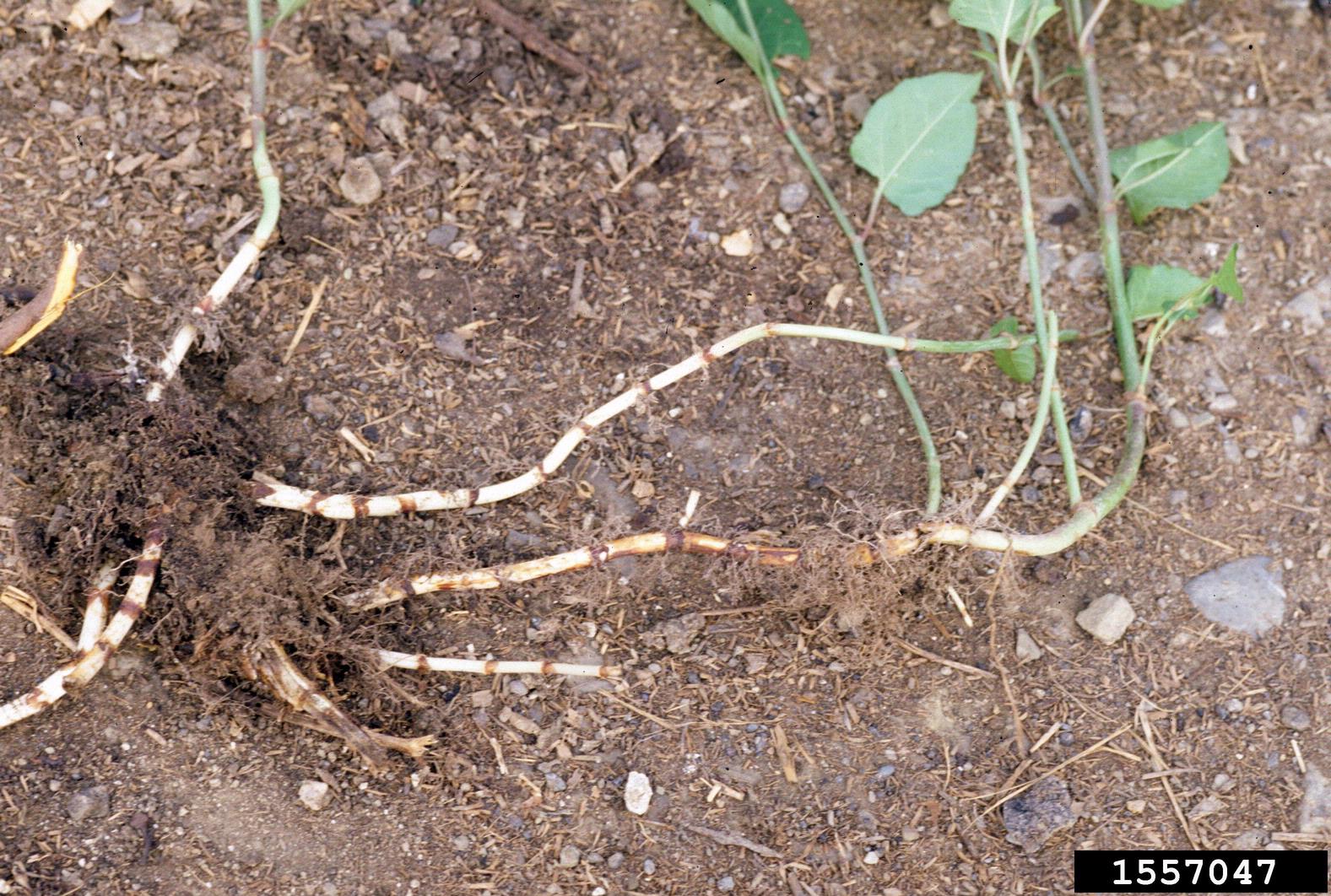
Japanese knotweed roots
It frequently grows in ecosystems where temperatures are relatively moderate, rather than extremely hot or cold. Commonly found on roadsides, waste places, and near small bodies of water, it forms thick, dense colonies that crowd out any other plant species. Today, it is considered one of the top worst invasive species in the world. Its success is thanks to its tolerance of a very wide range of soil types, pH, and salinity.

Japanese knotweed is listed by the World Conservation Union as one of the world’s most invasive species. It was first introduced to Britain by the Victorians in the 100s as an ornamental garden plant, but now England spends over 2.8 billion dollars a year attempting to fight it annually. It increased the construction of the 2012 Olympic Stadium by over 70 million dollars! Japanese knotweed has invaded countries such as New England, Australia, and Tasmania. So far, the monster has been found in 39 out of 50 states in the US and 6 Canadian provinces. Japanese knotweed was subsequently introduced to the U.S. for use in ornamental hedges and for erosion control. The Japanese knotweed spreads is entirely through the deliberate or accidental movement of rhizome fragments or cut stems. It has an extraordinary ability to spread vegetatively, a process by which new organisms arise without production of seeds or spores, from crown, stem and rhizome (underground root).

Montclair is one of the sad towns that has been attacked by the monster. Japanese knotweed is located in our very own High School Amphitheater!! Montclair's own STEM department and a professor from MSU worked together to measure rates of photosynthesis, transpiration, and how the Japanese knotweed affected fresh water levels.
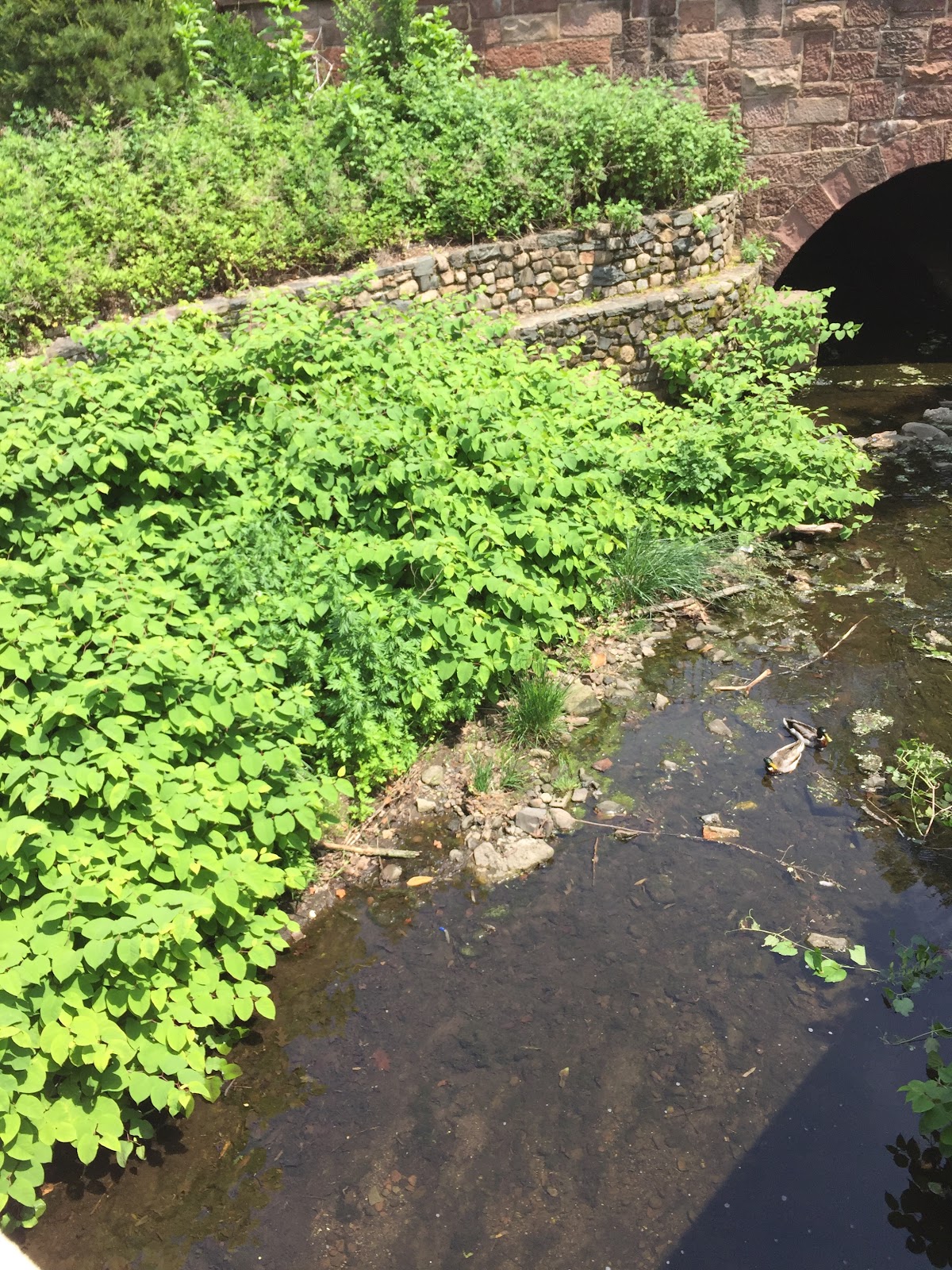
Toney's Brook in the amphitheater. The knotweed gets cut back every year for graduation but of course it grows back.
How do you know if you have the monster in your garden? Well that’s what we are here for! Japanese knotweed has hollow stems with distinct raised nodes giving the plant the appearance of bamboo, despite the plants not being closely related. The stem reaches a height of 3-4 meters each year, however smaller plants are everywhere too. The leaves are a broad oval shape with a base that is 7-14 cm long and 5-12 cm wide. The flowers are small, cream/white in color and are produced in late summer/early fall.

One of the most common ways to get rid of the monster is to eat it. A favorite recipe is Japanese Knotweed bread. This recipe was brought to us by Herbalpedia. In order to create this fabulous recipe you will need:

Materials
2 cups unbleached flour
½ cup sugar
1 ½ tsp baking powder
1 tsp salt
1 egg
2 Tbsp salad oil
¾ cup orange juice
¾ cup chopped hazelnuts
1 cup sweetened Japanese Knotweed Purée

Process
Preheat oven to 350F. Sift dry ingredients together into a large bowl. Beat the egg white with the oil and orange juice. Add along with hazelnuts and purée to dry ingredients. Do not mix until all ingredients are added, and blend only enough to moisten. Do not over mix. Spoon gently into buttered 91/2-by-5-by-3-inch loaf pan. Bake about 1 hour or until a straw or cake tester inserted in the center comes out dry. Cool by removing from pan and placing it on a rack. For muffins, spoon into buttered muffin tins and bake about 25 minutes.

By Brigie Coughlin and Samantha Chee

Thursday, June 2, 2016

Biggest species extinction since dinosaurs

Right now more species are becoming extinct since the mass elimination of dinosaurs 65 million years ago. And it's all because of human activity.


The Earth naturally goes through environmental cycles and species extinctions, yet the rate at which that occurs is generally one to five species a year, where as right now around a dozen are becoming extinct everyday! If this continues to happen, we could be looking at around 30-50% of all species becoming extinct by the mid-century.

Humans account for 99% of all activity threatening animals on this Earth, from habitat destruction, introduction of invasive species, and global warming. And because of the complex nature of ecosystems, one individual species could be a keystone species, causing a snowball affect of destruction on an area. Keystone species are organisms that greatly affect and are depended on in an ecosystem, where if removed cause dramatic change.

Species diversity is crucial towards successful ecosystems, and while certain terrains such as coral reefs and rain forests need genetic and species diversity,  less inhabited lands such as tundras, grasslands, etc could be completely devastated if a handful of species becomes extinct.

As humans, we must realize that we do not own this Earth, we are merely one species out of the millions of others. This human supremacy must be taken down and the realization that if actions aren't taken to preserve the multitude of living things, there will be a time with no elephants, red wood trees, killer whales, or the diversity that makes up our amazing Earth.

Phototropism in our Plants

Over the course of the year, there have been a few attempts by our biology classes to grow plants within our crowded classroom. First we worked with fast plants, which grew extremely quickly as the name suggests, then pansies, and we have now moved on to plant an assortment of morning glories and moonflowers. As the morning glories and moonflowers are beginning to develop however, it is plain to see that as their stems shoot up they don’t grow straight, but in a curved line. What is especially fascinating about this pattern of growth is that although the other plants we have grown were placed in similar conditions, except those being used in experimental groups, none of the other groups of plants seemed to have such an intense tendency to slant as they matured. The fast plants we grew did tilt slightly, but not to the same degree as the morning glories and moonflowers being grown now. Below are two images, on the left are fast plants and on the right are some of our moonflowers and morning glories:
IMG_2337.JPG
Fast Plants Moonflowers and Morning Glories
The phenomenon we are noticing is not unprecedented, in fact we learned about it during our studies this year, and it is called phototropism. Phototropism is the potential of a plant to elongate to move towards or away from light. This process works because plants produce a hormone called auxin, which promotes the elongation of coleoptiles, in their tips and then spread it to their other cells. When there is only one light source the hormone spreads unevenly throughout the plant, accumulating on the dark side and causing it to grow more quickly, resulting in the curve of the plant.
The direction that our plants are leaning is consistent with the explanation of what phototropism is since our plants are growing towards the window, which has a greater source of light than what can be found in the classroom. Still, it is peculiar that these plants are sitting under grow lights, which are artificial lights designed to stimulate plant growth by emitting wavelengths of light sufficient for photosynthesis, and surrounded by light from the windows and the classroom, yet they arch to one of these three light sources that surround them. An even more peculiar question to pose is why did the other plants we grow not arch to the window when they were subject to the same conditions? Do we keep the classroom lights off more than we did during other times of the year because the temperature is so high and we want to remain cooler? Is the fact that it is summer in our part of the world and we have a more direct angle towards the sun changing our results? Are the grow lights not on as consistently as they were during other times of the year? Or maybe the shorter amounts of daylight that we experienced earlier in the year caused the plants to rely more on the artificial lights than the current plants do, resulting in straight as opposed to curved growth.

All of these questions can be overwhelming, but it is the nature of scientists to be curious and pose questions from their observations. As Albert Einstein once said "The important thing is to not stop questioning. Curiosity has its own reason for existence." If scientists were not able to formulate questions and quandaries from the information they gathered, then no new theories or hypothesis would ever arise, and there would be no need for experiments to support or disprove new ideas. Essentially, science would not exist as it does today because there would be a halt in the flow of ideas and experimentation. Scientific discoveries would stop. And although so many unknowns is a lot to process and analyze, forcing oneself to answer them allows a person to realize details that they might have otherwise overlooked. In the case of explaining the phototropism in the morning glories and moonflowers for example, after asking all of these questions I remembered that the grow lights were lower when the fast plants were growing, which could account for the fast plants not having as extreme of a slant. Moonflowers and morning glories also grow on vines, which means that the slant the plants have exhibited thus far could represent the tendency vines have to bend and twist. 
Hopefully more investigation will be able to yield a definitive answer to the cause of phototropism in our plants before the end of the year, but whatever the cause it is remarkable that we are able to see some of the information we learned about in our biology class develop on its own before our eyes.

Bird Brain Doesn't Have to Be an Insult


In the story “The Crow and the Pitcher,” a famous tale from Aesop’s collection of fables, the intelligence of crows is remarked upon as a thirsty crow drops pebbles into a pitcher with water at the bottom to raise the water and allow him to get a drink.


Illustration of “The Crow and the Pitcher”

Although not a very scientific anecdote, there has been tons of research done to support the supposed genius of crows. Also called Corvus brachyrhynchos, crows are members of the corvid family, which includes jays, ravens, and magpies. Crows have a brain that is about the size of a human thumb, but relative to their body size that is enormous.The brains of crows are not just different from the brains of humans in that they are smaller however. In fact, mammalian and bird brains share few structures from before their divergence over 300 million years ago. Despite these differences, the decision making cells in humans and crows are quite similar. The intelligence of crows may even point to convergent evolution between humans and crows. With the relatively large brain of crows, they have been known to be toolmakers, creating hooks by bending wires to reach inaccessible food. Additionally, multiple studies have proven that crows are able to recognize analogies, and direct their behavior according to what they have learned. One of the more interesting versions of these studies was led by John Marzluff and a team at University of Washington. The Marzluff study involved one person wearing a caveman mask on the Seattle campus of the University of Washington and taking some of the crows in the area hostage. After these visits by a caveman masked person, Marzluff and some of his researchers would show up to the same area with either no masks or unfamiliar Dick Cheney masks and there would be no response from the crows. If anyone returned to the location in a caveman mask however, the crows would go wild, attacking the person they perceived to have abducted some of their own.


The caveman mask that was used in Marzluff’s study

This experiment proved that crows are able to recognize the faces of individuals and associate them with certain events or emotions. In the same lane, there have been other experiments similar to the typical design which presents an animal with two choices, one choice leads to a reward and the other a punishment, that crows have been involved in. One such experiment presented crows with three cups turned upside down. The center cup had an image on it, and the two surrounding cups each had an image as well, one matched the center image and the other was different. The cup with the matching image had food underneath, and if the crows motioned to that cup with their beak they were rewarded with the food. The crows quickly picked up the lesson and repeatedly chose the matching cup, and they were also able to switch to picking the different image quickly if the researchers moved the food to the cup with the different image.


With this research in mind, being called a bird brain no longer has the same sting. The information may otherwise seem unrelated to our lives, but there are actually a few applications the knowledge about crows can have in Montclair. Crows have been spotted in our own Rand Park, and because they have such an acute sense of learning that is not always present in other animals it is possible that they have picked up some hints on survival from the behaviors of park goers. As some of the aforementioned studies indicate, crows are able to learn quickly from trial and error what choices will benefit them, and they have the memory to applies those lessons in the future. Among the unfortunate heaps of litter in the park, crows may have potentially discovered that if they look in certain types of containers left on the ground (or in the trash cans) there will be leftover food for them. A more solidified adaptation of birds that could affect how they interact with us while in Rand Park is their affinity to fly away from people who look directly at them, while ignoring people who walk past them with averted eyes. A habit developed from big city living, crows may prolong their stay in our park if they don’t feel threatened by any direct observation of them.


Crows often have a bad representation in the media, from their portrayal in the Hitchcock movie The Birds or even from the mention of their related corvid in Edgar Allen Poe’s poem “The Raven.” Crows may be quite mischievous in their actions, as can be shown by a raven named Canuck stealing a knife from a crime scene in Vancouver, Canada, but they can also be friendly and warm. One great example of the friendly interactions possible to have with crows is the pattern of crows bringing little trinkets to a girl in Seattle, Washington who was feeding crows with the help of her mother in her backyard. So contrary to their scary portrayals, crows are majestic and intelligent creatures that make a great addition to Rand Park. There may even be some notable relationships developing between crows and Montclair High School students in the future.

If you want to know more about Marzluff's study of crows with masks then watch this video: https://www.youtube.com/watch?v=bOkj7lJpeoc

This link also tells more about Marzluff and the trinket-leaving ravens: http://www.cbsnews.com/news/new-research-looks-into-crow-brains-intelligence/

Also, if you want to know about the raven who stole a knife from a crime scene click here: http://www.cbc.ca/news/canada/british-columbia/crow-knife-crime-scene-1.3600299


Why We Should Appreciate the Oak Trees in Rand Park

Oak tree (Quercus alba) in the amphitheater in Rand Park
While the acorns that fall on your head as you walk through Rand Park on fall mornings might be annoying, we should be grateful for the trees that they come from. The oak tree has won the prestigious title of being America’s National Tree, and not without good reason.With a rich history and sturdy wood, the oak stands tall among us, silent and humble yet vitally important. Oak trees have been our steady companion ever since the indigenous people of North America used its leaves, flowers, and bark for medicinal purposes, and its tannins for dying and tanning hides. Eventually, though, Europeans arrived, yet the oak tree is so versatile that it benefited them as well. They used it for building furniture and houses; oak wood is especially useful for this because of the uneven vessel growth that adds to its structural integrity. Not only is it strong, but it is also impressively good at burning, which is actually great for people who want fuel, and oak wood has often been used to make charcoal. Even today, the oak tree is standing by our side and making our environment a better place to live. It’s deep and extensive root system stabilizes slopes and limits erosion. This tree can also trap airborne particles to reduce air pollution, and capture noise and moderate temperature in urban areas. Clearly, the oak tree is an extraordinarily important part of our past, present, and, most likely, future.


Other than directly benefiting humans, there are certain aspects of the oak tree that are worth mentioning. In North America, the most common type of oak is the white oak, a tree with smooth, rounded leaves and rough bark, varying in colors from brown to light gray. Oaks are also characterized by their wind-pollinated flowers and fruits (acorns). Male flowers in oak trees gather a lot of pollen for wind-pollination, while female flowers wait a little longer to mature to avoid self-pollination. These trees also produce acorns, which are a valuable resource, as it provides food and shelter to many different species, such as birds, squirrels, bats, etc. Acorn production is so important to biodiversity that crop failure can lead to the extinction of certain species.
The Seven Sisters Oak is the largest Southern live oak in the country, estimated to be 1,500 years. Image from Wikipedia
We should feel lucky to have a tree as active and valuable, as beneficial to the environment, as the oaks in Rand Park.

The Relationship Between Epigenetics and Oppression

Throughout the history of America, African Americans have faced extreme oppression and racism. Even today, African Americans are still suffering politically, socially, economically… and genetically. The systemic inequality found in this country has had an impact on more than just social status - it has influenced human biology at the cellular level, causing the oppressed to be more vulnerable to disease.
By studying epigenetics, the science of how external factors affect our gene expression and function, scientists have found that there are certain aspects of African American biology that have been negatively altered due to years of suffering under slavery and Jim Crow laws. The cells of people who have experienced a lot of physical or emotional abuse react strongly to stress, especially during development times in the womb, which can make the child more susceptible to disease later in life. The mistreatment that African Americans endure can alter the expression of certain cells that control important bodily functions, and that can also lead to more negative health consequences. It has been found that African Americans have a much higher level of cortisol, the body’s “fight or flight” hormone, than is normal for a human. This can reshape the behavior of cells that regulate blood pressure, kidney function, and cardiac function.
While this information may seem contrary to all that Darwin has taught us about evolution, it does not actually refute his findings. Rather, it adds to it, providing us with a deeper and more complex understanding of the ways in which evolution works and affects our lives.
After centuries of mistreatment towards African Americans, epigenetics is revealing that they are not only more prone to worse social and economic situations - they are also more prone to diseases. This issue is especially important in the debate over reparations, and I think that more research should be conducted into the role of epigenetics in the lives of descendants of those who suffered under slavery and Jim Crow laws.


Of Telomeres, Eternal Youth, and Lobsters

If you have taken AP Bio, you will know that when DNA replicates, a small piece is cut off of the end each time (see the following image to attempt to understand, they explain it far better than I could).


Now, as one can imagine, when a piece of DNA is being removed with each replication, the entire strand is going to be shortened more and more over time. DNA replicates hundreds of times in the human lifespan, and it’s pretty unhealthy to lose all that DNA, right?

That’s where telomeres come in. Telomeres are pieces of DNA that hang out on either end of the functioning strand and that do not code for anything at all in the cell’s genes. They’re essentially buffers for the DNA, as when the DNA is replicated, only the telomeres are removed.

Until time runs out. 

There are only so many telomeres — humans can have up to 15,000 base pairs (letters, if you will) in their telomeres. And DNA replication happens frequently. Sooner or later, everyone runs out. And many scientists believe this is a root cause of the human aging process.

Now meet the Lobster.
This guy doesn’t have any of our telomere problems — because he can regenerate his telomeres.

Lobsters possess a special enzyme called telomerase, which rebuilds their telomeres between divisions. This means that no matter how many times a cell divides, it’s nowhere closer to having its DNA destroyed. And the lobsters don’t get old. 

Throughout its life (which can be over 100 years!), a lobster maintains a pretty constant state. His skin (shell?) does not sag and his metabolism does not slow down. They are as youthful as ever, and scientists believe this is because of the benefits of telomerase. Lobsters will eventually die, usually because of predators, but sometimes because they just can't make shells big enough to fit in anymore, but their lives are very different because of this unusual enzyme. 

Now here's where it gets even wilder. Turns out humans have telomerase too -- in children's growth cells, and in cancer cells. Turns out the same enzyme that allows lobsters to stay young is killing millions of people. This weird pattern has generated some important questions: 

Could the lobster be the secret to eternal youth? Could it help us stop cancer?

We’re not sure yet, but these phenomena look pretty interesting nonetheless. Scientists are hoping that telomerase will help us fight cancer, improve skin graft treatment, and, of course, combat aging. Many are working with it right now, and I, personally, am very excited to see where it goes. 

If you want to find out more, check out the following: 
Dr. Joe Dispenza
Smithsonian Magazine


Compost Happens


slogan
Whether you resided in a classic suburban development, a never sleeping city landscape or even the big sky country of Iowa, you have an effect on the earth. Now, don’t get the wrong idea, this is not going to divulge into a pro and con list of different lifestyles or the merits of carbon footprints and global warming. This will, however, divulge into a comprehensive list of a simple way to clear up your guilty conscious for all the times you littered as a teen or purchased non-free range meat out of convenience. You are probably asking yourself what could possibly be the godsend miracle that holds power to decontaminant the guilt from your 8th grade wild days. The answer is simple; compost.
A $798.99 Comopst Tumblr available on Ebay
You may be doubtful at this very point in time but that is probably because you don’t understand the complexity and miraculous concept that it is.  Sustainable America, whose name gives it all the credibility it needs in my book, explains how compost is a complex science that can be easily tackled by everyday americans like you. Math is hard and the idea of a ratio involved in composting may be off putting but keep an open mind. You need a 1:2 ratio of carbon-rich matter or browns, like dead leaves, with nitrogen-rich organics or greens like grass clippings and then just add all your food waste to the bin to create the compost of your dreams. Now to tackle the bin misconceptions. Yes it is true that you could spend upwards of $500 on a bin, through my extensive research I even found one that was on sale for $798.99, but you could also not. Simple plastic bins for $4.99 are available at your local hardware store or in the spirit of recycling, you could just reuse an old plastic container you have laying around. Their downside is the extended time it takes to kickstart the compost process but patience is the key of life. If you feel like splurging you could invest in a tumbler, a hamster ball but bigger, or even a worm-infused bin, but for beginners, just go with plastic and make your life easier.
Compost worms
Worms are a man’s best friend when it comes to composting. Specifically, red worms or Eisenia fetida can speed up the process if kept in a cool but not too cold environment. They are about 100% less maintenance that the traditional friend, a dog, but the emotional appreciation you will experience when you see your compost is just as strong as a welcome-home-greeting from your puppy. In layman's terms, the worms eat the food waste and then poop out the good stuff, it really is just that simple. If you live in an area blessed, or cursed, with the season of winter then composting ends as the first sign of frozen hair in the morning but if you use worm-composting, the end of the year flurries mean nothing. Worm bins can be placed under sinks or basements and have no odor unless you overburden the worms with too much food. Solutions are easy, candles and less food, so don’t let the possible odor deter you. In fact, as I was writing this post, I discovered that I have spent 44 minutes a day, 5 days a week since September in a room with these very worms. Not only did I never notice, or smell them, but I never appreciated how amazing the creatures a mere five feet away from me were.
A compost bin with food waste 
A common name associated with compost is black gold. Yes, gold, the block of solid yellow you probably saw as the most expensive and luxurious thing as a child. Composting really is on the same level of gold, and everyone should start seeing it as just that. Seattle, the land of starbucks and Meredith Gray, introduced a composting law that fines individuals and companies for throwing the gold-status food scraps in the trash instead of the composting bin. Mayor Ed Murray assured his citizens that the law is not meant to create revenue, it is meant to encourage people to be conscientious of their environment and of their actions. In fact, the city is spending upwards of $400,000 on educating their residents about the new trash law, but it is just that important. Seattle should be applauded for being a model of how every state should value the Earth, and hopefully one day, every city will follow in their footsteps.
Composting is your friend and your savior. Remember all the times you left your car idling for a minute too long or watched the napkins fly away from your picnic and didn’t chase them. Those things had a detrimental affect on our planet, even if you just did it once, we can all feel the effects. Take this post as a reason to go out and start creating your own black gold. You’ve taken a tremendous amount from the earth you live on and it’s time to go out and compost.

Wednesday, June 1, 2016

Baby Birds in Our Own Backyard

There’s a robin’s nest in Rand Park! And it has baby birds in it! To protect the birds we can’t disclose its location. When we first discovered the nest, there were three baby birds and two unhatched eggs. We knew they were robins because of the blue eggs. The blue color in robin eggs is due to biliverdin, a pigment deposited on the eggshell when the female lays the eggs. There is some evidence that higher biliverdin levels indicate a healthier female and brighter blue eggs. Eggs laid by a healthier female seemed to encourage males to take more interest in their young. Robins usually lay four eggs and then stop, which was the case with this mother robin. Typically the mother lays one egg a day and then the eggs hatch in the order they were laid in. In that case, the two unhatched eggs were laid later than the hatched eggs. The female incubates the eggs for two weeks until they hatch and then both parents care for the young.


I didn't get a picture of the birds before hatching but here's a picture from Google Images.
The babies will become fledglings two weeks after they hatch, which means that their feathers and wing muscles are developed enough for flying but they are still dependent on the care of the parent. Birds learn to fly through practice, guided by their innate ability and the example of their parents. Flying is an innate ability but a learned behavior.
A majority of the robins fly south for the winter, but some stick around. Robins that do not migrate tend to move around during the winter, motivated by food. Robins eat berries in the winter and worms and insects in the spring when the ground thaws. Robins have to wander around during the winter to follow the food supply.

The mother robin starts screaming when I get near the nest to take a picture. I’ve only done it twice because I don’t want to cause her or the babies any stress. Contrary to popular belief, parents will not abandon their babies if they come in contact with humans. However, if you find this nest or any other, PLEASE respect the birds and don’t mess with it or share with anyone else.


First picture of the babies taken on May 23rd
Second picture of the babies taken on May 26th! Look how much they've grown! (creds to Ms. Eckert for the photo)
I raised a baby robin a couple years ago named Chirp Chirp. He was a fledgling when I found him but he wasn’t old enough to survive the world on his own. I fed him cat food dissolved in water from an eyedropper because it is a good source of protein and fiber. I squirted the food into his open mouth from above to try to mimic his parents throwing up into his mouth (ew!). When he got older I bought mealworms from Petco and dangled those above his head. 
Creds to Google Images
He got really good at flying and I was so proud. I’m not sure how he learned because he didn’t have a real bird mom to teach him but maybe he learned by watching birds outside. The interweb says flying is a learned behavior but this experience made me think it is more innate. Chirp Chirp soon flew away from me and I cried, but I couldn’t be more proud of my baby. Every time I see a robin I think of him and wonder if it’s him coming back to say thank you.
UPDATE!
The kids have left the nest! Ms. Eckert brought the nest inside. Most websites say that robins don't reuse their nests. One says that they sometimes build on top of them or reuse parts of it. I think it might have been better to leave it where it was but looking at the nest up close allowed us to see how the robins had constructed it. We saw that it had a plastic bag and the plastic ring around the top of bottles. Do you think these materials are dangerous for the birds? Maybe it's time to start throwing our trash where it belongs- in the garbage can.
The empty nest :( A sad but proud moment

Understanding the Impacts of the Genetic Diversity of a Wider Range of Americans

I recently read a New York Times article titled, "Tales of African-American History Found in DNA," and felt that a new discovery made by team of geneticists from McGill detailed in the article was too important not to share. While African Americans' harsh transatlantic journey to the U.S. to become slaves and their later migration from the South to cities in the North in the 1900s are significant and understood pieces of history, African Americans' genetic variation that arose as a result of such migration has not been investigated....until now. 


The team of geneticists at McGill evaluated the DNA of thousands of African Americans in three different medical studies. They discovered that the ancestors of the average African-American today were 82.1 percent African, 16.7 percent European and 1.2 percent Native American. You might be asking yourself why such findings are important. Well, besides the historical impact this research has,  the information revealed about African Americans' health is extremely significant. The map of genetic diversity created "will show how genes influence their risk for various diseases," according to the McGill geneticists. Most known information about the relationship between genes and disease has been centered around those of European descent, but now the focus has been broadened. Already, scientists have found a potential drug for heart disease through a rare genetic mutation found in African-American woman. Thus, more information on African American genetic diversity leads to not only benefits for African Americans, but discoveries that may benefit all people.

Tuesday, May 24, 2016

MHS’ Contribution to Garbage Island: Part 1 Look into the Litter Epidemic

By Genevieve Basso 

Monday-it’s only first period- students already sit in their classes, under slept and overwhelmed like another other first day back to school; the May weather calls from window to outside. Today we’ve begun examining the litter at Rand Park. A quick glance at the first trashcan by the west facing descending, entrance gives us a good indication of the exact scale we’re dealing with here- and it’s greater than what was originally hypothesized. We count more than 5 pieces of trash happily sitting on the ground- directly next to that trashcan- a further examination of the park leads us to the realization: most individuals passing through prefer to throw their waste on the ground rather than in trashcans. Since it’s the morning every trash bin is relatively empty, yet that’s not the same for the rest of the land paralleling the Freshman building. Below is a series of pictures compiled during the search for litter displayed in a collage, all photos we’re taken within 5 minutes of entering the park to give you an idea of just how much we’re dealing with. 


Now imagine how long all the garbage would collectively take to completely decompose. When estimating long term rates of decomposition scientists can use respirometry tests to measure the rate or carbon dioxide production of oxygen consumption of organic matter or an organism. This is done by placing the object being sampled in a container containing soil and microorganisms, followed by ensuring there is an oxygen supply and allowing for circulation. In the days to follow the microorganisms slowly digest the sample while producing carbon dioxide which levels serve as a indicator of degradation rate.
If you'd like to calculate how long your garbage would take to decompose check out this handy chart: 
(Special thanks to http://sciencelearn.org.nz/ for the data)


That’s all for now, check back for an update on a “Look into the Litter Epidemic "