Showing posts with label Brook. Show all posts

Friday, June 3, 2016

The Monster in Your Garden

Most people have seen it. It surrounds brooks, rivers, streams, and houses. It will take over your land, one square inch at a time, preventing organisms from surviving. Once it comes, it almost never leaves. This demon is your worst nightmare. It will prevent you from selling your house, it will destroy your land, it is Japanese Knotweed also known as Fallopia japonica.

Japanese knotweed is native to East Asia in Japan, China, and Korea. This plant grows rapidly and spreads quickly as well with up to 2 meters in one season. Its underground root system can even stretch for 7 meters! 
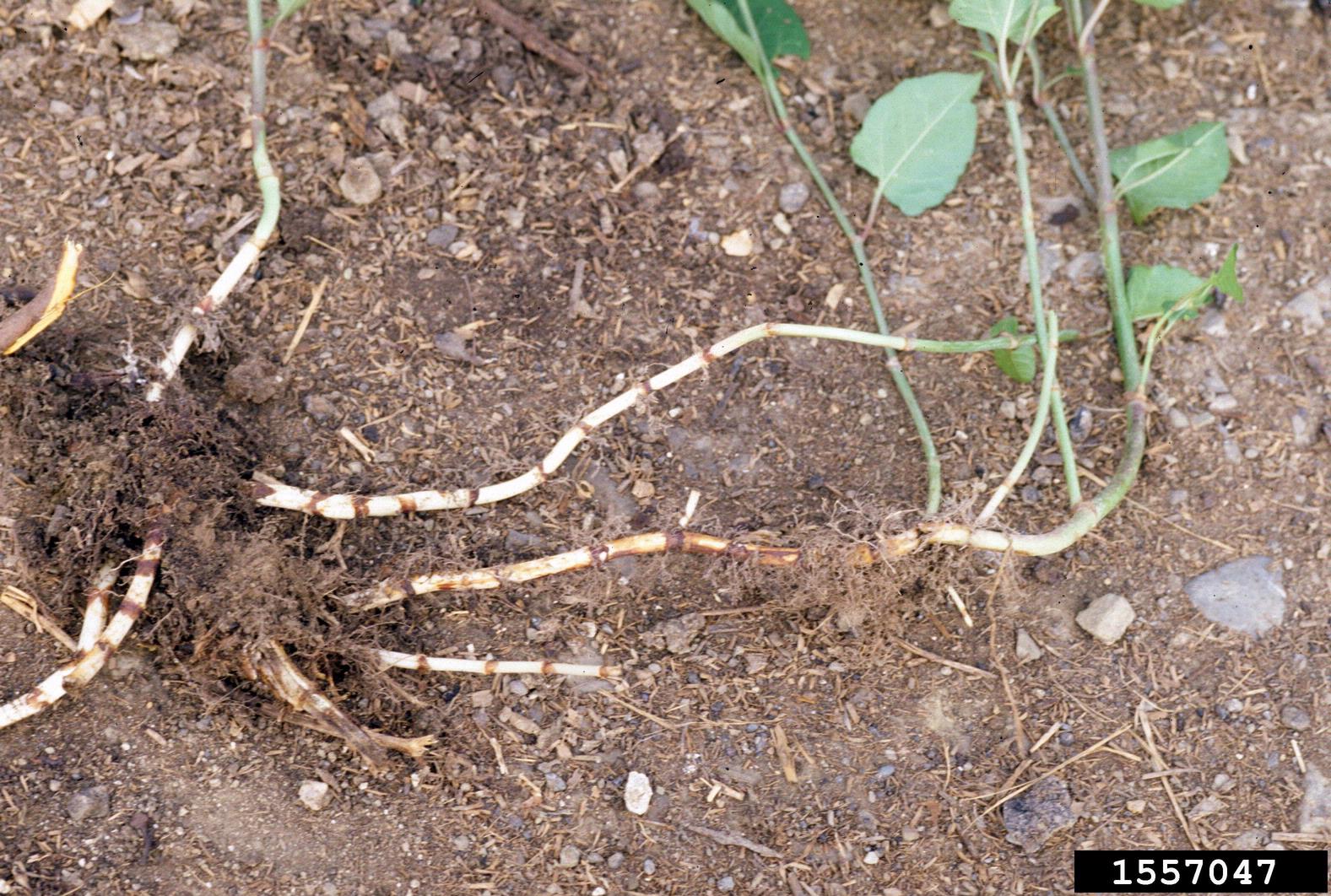
Japanese knotweed roots
It frequently grows in ecosystems where temperatures are relatively moderate, rather than extremely hot or cold. Commonly found on roadsides, waste places, and near small bodies of water, it forms thick, dense colonies that crowd out any other plant species. Today, it is considered one of the top worst invasive species in the world. Its success is thanks to its tolerance of a very wide range of soil types, pH, and salinity.

Japanese knotweed is listed by the World Conservation Union as one of the world’s most invasive species. It was first introduced to Britain by the Victorians in the 100s as an ornamental garden plant, but now England spends over 2.8 billion dollars a year attempting to fight it annually. It increased the construction of the 2012 Olympic Stadium by over 70 million dollars! Japanese knotweed has invaded countries such as New England, Australia, and Tasmania. So far, the monster has been found in 39 out of 50 states in the US and 6 Canadian provinces. Japanese knotweed was subsequently introduced to the U.S. for use in ornamental hedges and for erosion control. The Japanese knotweed spreads is entirely through the deliberate or accidental movement of rhizome fragments or cut stems. It has an extraordinary ability to spread vegetatively, a process by which new organisms arise without production of seeds or spores, from crown, stem and rhizome (underground root).

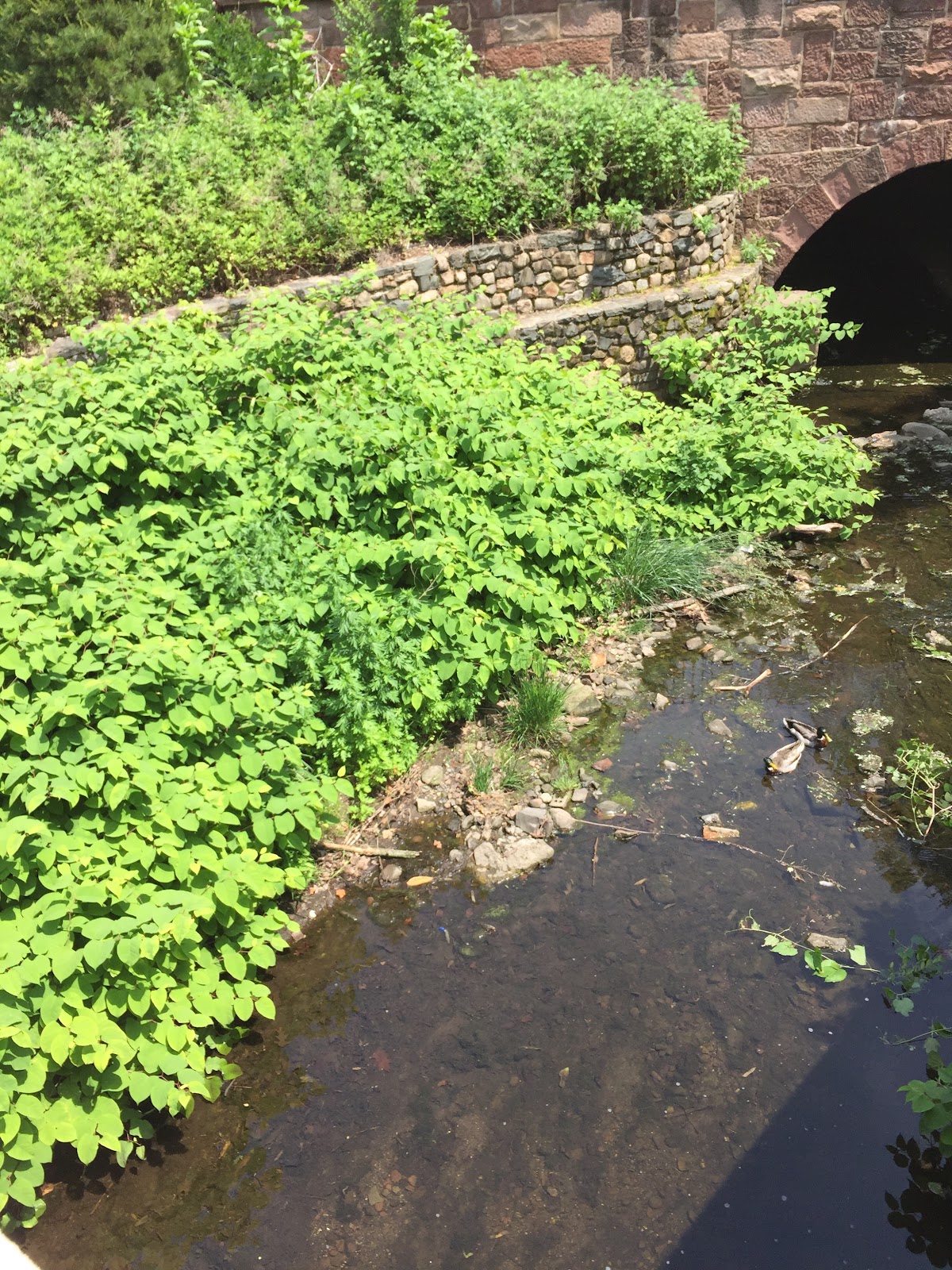
Montclair is one of the sad towns that has been attacked by the monster. Japanese knotweed is located in our very own High School Amphitheater!! Montclair's own STEM department and a professor from MSU worked together to measure rates of photosynthesis, transpiration, and how the Japanese knotweed affected fresh water levels.
Toney's Brook in the amphitheater. The knotweed gets cut back every year for graduation but of course it grows back.
How do you know if you have the monster in your garden? Well that’s what we are here for! Japanese knotweed has hollow stems with distinct raised nodes giving the plant the appearance of bamboo, despite the plants not being closely related. The stem reaches a height of 3-4 meters each year, however smaller plants are everywhere too. The leaves are a broad oval shape with a base that is 7-14 cm long and 5-12 cm wide. The flowers are small, cream/white in color and are produced in late summer/early fall.

One of the most common ways to get rid of the monster is to eat it. A favorite recipe is Japanese Knotweed bread. This recipe was brought to us by Herbalpedia. In order to create this fabulous recipe you will need:
Materials
2 cups unbleached flour
½ cup sugar
1 ½ tsp baking powder
1 tsp salt
1 egg
2 Tbsp salad oil
¾ cup orange juice
¾ cup chopped hazelnuts
1 cup sweetened Japanese Knotweed Purée

Process
Preheat oven to 350F. Sift dry ingredients together into a large bowl. Beat the egg white with the oil and orange juice. Add along with hazelnuts and purée to dry ingredients. Do not mix until all ingredients are added, and blend only enough to moisten. Do not over mix. Spoon gently into buttered 91/2-by-5-by-3-inch loaf pan. Bake about 1 hour or until a straw or cake tester inserted in the center comes out dry. Cool by removing from pan and placing it on a rack. For muffins, spoon into buttered muffin tins and bake about 25 minutes.

By Brigie Coughlin and Samantha Chee

Wednesday, June 1, 2016

Parasitism in the Brook

So for my blog post, I thought it might be interesting to have a look at the brook water, perhaps get a sample of the freshwater and put it under a microscope, look at the microorganisms. After getting some water, I thought it might also be interesting to get some muck from the bottom of the brook. This proved challenging, as most of the bottom was rocks, but after some digging I managed to get some muck in a plastic container with my bare hands. Below is a picture of muck after being taken in to the classroom.


i left the muck as it was for a day, and fortunately, my valiant bio teacher went through it and had a look around in its contents. However, when I came back the next day I got a nasty surprise. I assumed that the muck was mostly soil and plant matter. But, this muck, which I hand picked out of the brook, had held something a little larger than some measly microorganisms.


For those who haven't had the pleasure of being up close and personal with one of these monstrous abominations of science, this is a leech. They drink blood. And apparently they are all over the Rand Park's brook. Later on I found another leech in the same muck which appeared to be dead, only to suddenly spring back to life as I poked it. Later the next week I investigated the brook and found another two under the soil bottom of the brook. This news is a bit gross, considering that many people have occasionally taken a stroll through the brook, or in the case of many freshman, practically live in it. Perhaps they should be informed of the parasites living in the brook so they don't climb out, unwittingly carrying bloodsucking worms.


For those who don't know, which I imagine is all of us, leeches are members of the phylum Annelida, which also houses common earthworms. Not all drink blood but the majority do. There are so many species of leech that it was hard to potentially identify the species, so my rough guess would be Macrobdella decora. I'm very uneducated in this topic however, so I'm open to see what other people who have more experience that I do would think. They're a fascinating group of organisms, not just because they consume blood, but in the matter that they do so. They traditionally attach themselves to another organism with the sucker above, and drink with their smaller mouth. They then drink the blood while applying an anticoagulant to prevent blood from clotting and ceasing to flow. I can attest to how strong they latch onto prey and how it's not simply a matter of pulling them off. You can try, but you stand a high chance of getting the leech's teeth and other mouth parts lodged inside your skin. And for many people, myself included, you can end up with an allergic reaction that doesn't stop until the leech parts have naturally left you. Leeches are special in that they can survive on only one meal a year. This is due to two factors. The first is that a leech is able to take in five times as much blood as its body mass, so it swells up greatly to store as much food as possible. Second is that their guts inhibit microbial decay of the blood, so the food is not digested. This means they can keep the blood for a very long time, only breaking it down when it is actually needed.


Despite their absolute disgustingness and morbid association, leeches actually aren't harmful. They take a minimal amount of blood from us and drop off when done. They can carry disease spread through blood contact, but this is only in areas where these diseases are prominent, such as in southern Africa, where leeches have tested positive for HIV and hepatitis B. Leeches can even be rather helpful in modern and ancient medicine, where they are applied to patients who may have problematic venous congestion. The anticoagulant allows the blood to not clot or flow out of the body to prevent build up. These days they have even used recombinant technology to recreate the anticoagulant without the leeches. So in the end, something that we, or at least I, find disgusting, actually has an important purpose in saving lives.