Showing posts with label Trash. Show all posts

Thursday, June 2, 2016

MHS' Contribution to Garbage Island: Part 2-Change is Possible!

Garbage and the enormity of it is piling up throughout the world, including the small park Montclair High School is located on. Adolescents blatantly throw their trash into Rand park, instead of the trash cans located throughout the area.


The immediate solution to help reduce the garbage amount would be to educate and inform the high school students, especially the incoming freshman, on the impact trash has on the environment and on the small scale, the beauty of Rand Park. By freely littering the high school campus, it not only reflects poorly of the students, but prevents any improvement of the park from happening. Local government believe that putting in money and time into Rand Park would be pointless and ineffective because of the continuous stream of trash being dumped into the park by the MHS students. And while this is partly true, perhaps the upkeep of the park would motivate and inspire others to stop littering.


Getting students involved in the maintenance of the park is a first easy step to help the "Garbage Island" of Montclair. With countless community service clubs, students could get service hours in exchange for time spent cleaning the park. For example, Key Club, a community service club where every member must have a minimum of 50 hours of volunteer work a year, that has over 100 members could easily transform Rand Park into the beautiful breath of nature it is meant to be. After school, students could congregate and comb the area for litter, help maintain the landscape, and oversee something with meaning. Additionally, Peer Leadership, a mentor group of seniors that help freshman orient into high school life, could inform incoming students about how the responsibility they have in keeping Rand Park clean and litter-free.


After digging into this problem we brainstormed alternative solutions; of course there’s always the possibility of the town providing additional trash and recycling cans, in hopes that the majority will actually use them. But the reality is to end any problem one must go to the source, if the student body and administration would support a movement to keep campus litter free with security guards doubling as waste monitors we could eliminate much of the litter. However, one of our biggest issues facing this epidemic is out of our control, using plastic- specifically styrofoam. Food trucks are part of the natural order at Montclair High, but with their continuous usage of non-environmentally friendly products to serve their products it’s not difficult to hypothesize where the majority or trash originates from. One way this town could rewrite that construct is introducing vendors to companies creating products targeting sustainability rather than saving money.


Then we stumbled up Eco Products: "a green company who happens to operate in disposables”, the company creates kitchenware, such as utensils, targeted as "sustainable disposable products"- oxymoron much? But the company's values and goals intend to follow through on their claim, calling worker "greengeeks" as well to aid promoting this go green philosophy. The company claims every product uses materials made from renewable resources and recycled content.
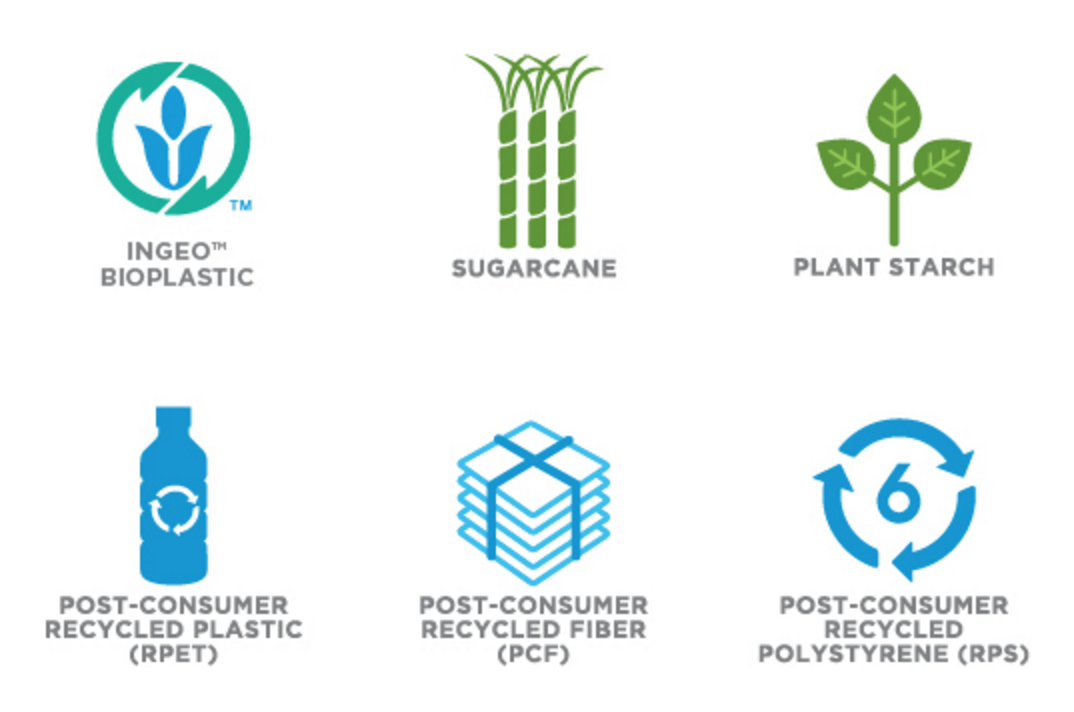
A few of Eco Products top used materials, provided by ecoproducts.com


You can check out their website here:
Or find your nearest location to buy their biodegradable products here:

Compost Happens


slogan
Whether you resided in a classic suburban development, a never sleeping city landscape or even the big sky country of Iowa, you have an effect on the earth. Now, don’t get the wrong idea, this is not going to divulge into a pro and con list of different lifestyles or the merits of carbon footprints and global warming. This will, however, divulge into a comprehensive list of a simple way to clear up your guilty conscious for all the times you littered as a teen or purchased non-free range meat out of convenience. You are probably asking yourself what could possibly be the godsend miracle that holds power to decontaminant the guilt from your 8th grade wild days. The answer is simple; compost.
A $798.99 Comopst Tumblr available on Ebay
You may be doubtful at this very point in time but that is probably because you don’t understand the complexity and miraculous concept that it is.  Sustainable America, whose name gives it all the credibility it needs in my book, explains how compost is a complex science that can be easily tackled by everyday americans like you. Math is hard and the idea of a ratio involved in composting may be off putting but keep an open mind. You need a 1:2 ratio of carbon-rich matter or browns, like dead leaves, with nitrogen-rich organics or greens like grass clippings and then just add all your food waste to the bin to create the compost of your dreams. Now to tackle the bin misconceptions. Yes it is true that you could spend upwards of $500 on a bin, through my extensive research I even found one that was on sale for $798.99, but you could also not. Simple plastic bins for $4.99 are available at your local hardware store or in the spirit of recycling, you could just reuse an old plastic container you have laying around. Their downside is the extended time it takes to kickstart the compost process but patience is the key of life. If you feel like splurging you could invest in a tumbler, a hamster ball but bigger, or even a worm-infused bin, but for beginners, just go with plastic and make your life easier.
Compost worms
Worms are a man’s best friend when it comes to composting. Specifically, red worms or Eisenia fetida can speed up the process if kept in a cool but not too cold environment. They are about 100% less maintenance that the traditional friend, a dog, but the emotional appreciation you will experience when you see your compost is just as strong as a welcome-home-greeting from your puppy. In layman's terms, the worms eat the food waste and then poop out the good stuff, it really is just that simple. If you live in an area blessed, or cursed, with the season of winter then composting ends as the first sign of frozen hair in the morning but if you use worm-composting, the end of the year flurries mean nothing. Worm bins can be placed under sinks or basements and have no odor unless you overburden the worms with too much food. Solutions are easy, candles and less food, so don’t let the possible odor deter you. In fact, as I was writing this post, I discovered that I have spent 44 minutes a day, 5 days a week since September in a room with these very worms. Not only did I never notice, or smell them, but I never appreciated how amazing the creatures a mere five feet away from me were.
A compost bin with food waste 
A common name associated with compost is black gold. Yes, gold, the block of solid yellow you probably saw as the most expensive and luxurious thing as a child. Composting really is on the same level of gold, and everyone should start seeing it as just that. Seattle, the land of starbucks and Meredith Gray, introduced a composting law that fines individuals and companies for throwing the gold-status food scraps in the trash instead of the composting bin. Mayor Ed Murray assured his citizens that the law is not meant to create revenue, it is meant to encourage people to be conscientious of their environment and of their actions. In fact, the city is spending upwards of $400,000 on educating their residents about the new trash law, but it is just that important. Seattle should be applauded for being a model of how every state should value the Earth, and hopefully one day, every city will follow in their footsteps.
Composting is your friend and your savior. Remember all the times you left your car idling for a minute too long or watched the napkins fly away from your picnic and didn’t chase them. Those things had a detrimental affect on our planet, even if you just did it once, we can all feel the effects. Take this post as a reason to go out and start creating your own black gold. You’ve taken a tremendous amount from the earth you live on and it’s time to go out and compost.

Tuesday, May 24, 2016

MHS’ Contribution to Garbage Island: Part 1 Look into the Litter Epidemic

By Genevieve Basso 

Monday-it’s only first period- students already sit in their classes, under slept and overwhelmed like another other first day back to school; the May weather calls from window to outside. Today we’ve begun examining the litter at Rand Park. A quick glance at the first trashcan by the west facing descending, entrance gives us a good indication of the exact scale we’re dealing with here- and it’s greater than what was originally hypothesized. We count more than 5 pieces of trash happily sitting on the ground- directly next to that trashcan- a further examination of the park leads us to the realization: most individuals passing through prefer to throw their waste on the ground rather than in trashcans. Since it’s the morning every trash bin is relatively empty, yet that’s not the same for the rest of the land paralleling the Freshman building. Below is a series of pictures compiled during the search for litter displayed in a collage, all photos we’re taken within 5 minutes of entering the park to give you an idea of just how much we’re dealing with. 


Now imagine how long all the garbage would collectively take to completely decompose. When estimating long term rates of decomposition scientists can use respirometry tests to measure the rate or carbon dioxide production of oxygen consumption of organic matter or an organism. This is done by placing the object being sampled in a container containing soil and microorganisms, followed by ensuring there is an oxygen supply and allowing for circulation. In the days to follow the microorganisms slowly digest the sample while producing carbon dioxide which levels serve as a indicator of degradation rate.
If you'd like to calculate how long your garbage would take to decompose check out this handy chart: 
(Special thanks to http://sciencelearn.org.nz/ for the data)


That’s all for now, check back for an update on a “Look into the Litter Epidemic "