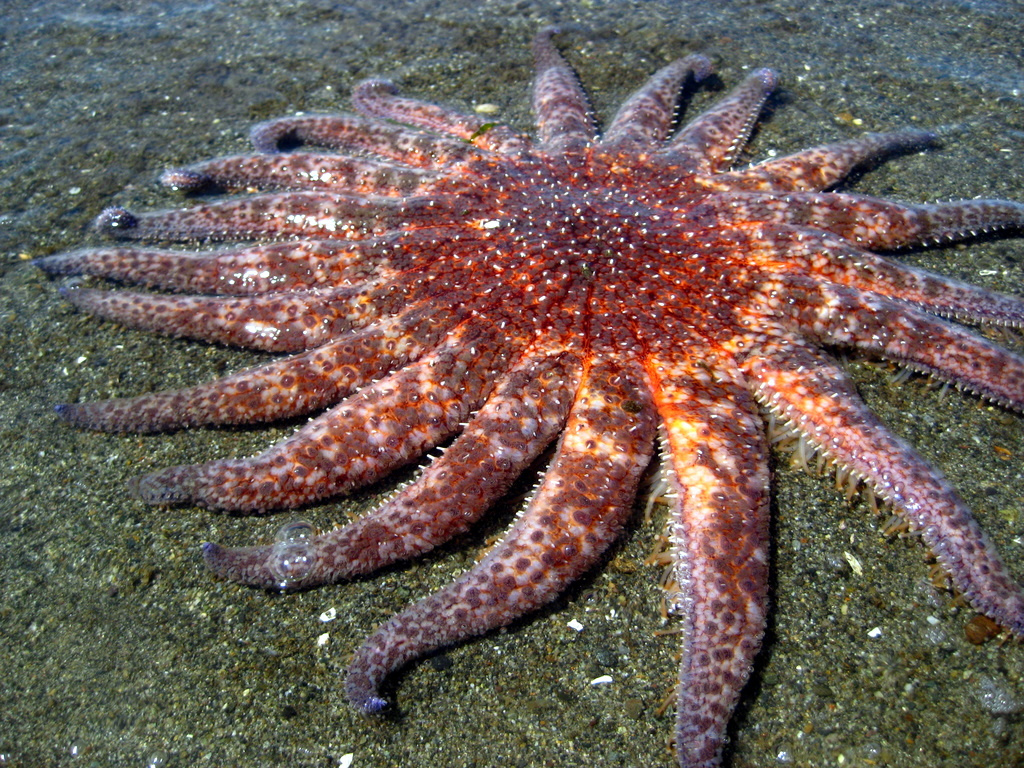
In 2014 kelp forests off the coast of California
suffered a drastic decrease in spore production due to a prolonged Pacific heat-wave that depleted their environment of vital nutrients. Since then, heat waves have become more common and more intense, and in the summer of 2019 a heat-wave allowed a disease to proliferate that destroyed the region's population of sunflower sea stars. Purple sea urchins, the sea star’s main food source, felt a population boom of 60 times their initial size. The urchins wreaked havoc on the unbalanced ecosystem, consuming nearly 90% of the bull kelp along 200 miles of California coastline. Red abalone sea snails suffered mass starvation, as the kelp was their main food source, and numerous fish species who nursed their young in the kelp suddenly were unable to foster new generations of fish. Bald eagles and harbor seals had to find new food sources and California was forced to close down abalone fisheries, worth around $44 million a year. Many commercial fisheries will not recover.
Sunflower sea stars looking very much like a predator,
here
The sea urchin boom leading to a catastrophic loss of kelp forests,
here
Now, I’m not going to waste time trying to convince you that climate change is happening. If you do not believe it’s happening, it’s human-caused, and it's reversible then you’re just
wrong. But what is often ignored is just how catastrophic small changes in our environment can be for the Earth’s biodiversity and complex human society. The crisis is a snowball cascading down a hill towards a cliff, the longer we wait to stop it the faster and larger it is, and eventually it will be impossible to stop its fall if it is not dealt with immediately.
The collapse of the ecosystem above is just one of the many human-caused environmental crises that have been happening ever since we learned to walk on two legs (see hunting mammoths to extinction in the Americas). In a country like the United States at this point in history, the collapse of a food source like abalone snails or the local fish populations are just a financial hit, but thousands of communities around the world depend on the ocean as a food source and will starve if anything like this happens there. Food scarcity leads to migration leads to conflict leads to food scarcity, it's a very well documented cycle.
But, as the little anticipating potential questions man in my head might ask, “Well the collapse of these fish populations are sad but they’re not gonna cause any large societies to collapse, right?”, and to that point I agree, but these are not isolated. The Intergovernmental Platform on Biodiversity and Ecosystem Services (IPBES), a UN organization, produced a
report in 2019 predicting that if warming is not kept below 1.5 degrees C (above pre-industrial averages), that we can expect to see a mass die-off of up to a quarter of species in the next 20 years. This includes 40% of amphibians, 34% of conifers, 33% of reef corals, 25% of mammals, and 14% of birds. If the collapse of one starfish population can destroy an ecosystem, imagine the scale of destruction that can be cause by those kinds of numbers. We have been seeing this since 2016 with coral bleaching of the Great Barrier reef, and these ecological scientists warn that if warming is not kept below 1.5 degrees that 70-90% of coral species would become functionally extinct, and if not kept below 2 degrees over 99%. According to the National Oceanic and Atmospheric Administration (NOAA)
reports that 25% of all fish depend on coral reefs for food, shelter, and breeding grounds. Over half a billion people depend on coral reefs for food, income, and protection (from storms), and they also provide vital environments for research into new medicines. And that isn’t even the worst of it.
Some of the most at-risk populations are the ones that help plants reproduce. Due to habitat loss, agro-chemical pollutants, invasive species, and climate change, pollinator populations are dropping rapidly. It's estimated in the UK that three times the pollinator species populations are decreasing rather than increasing, and bee populations are nearly extinct. In Germany, scientists revealed a stunning 76% decline in flying insect biomass over 27 years. And globally, an invertebrate abundance index has shown a 45% decline in the global population over the last 40 years. This decline has led to a rapid decline in bird populations, as they feed on the insects. Rhetorical question man strikes again, asking, “Why do I have to care about some stupid insects dying.” Well first off, dude, they're living creatures. But second off, insects and birds are an essential part of nearly every plant ecosystem on the planet. Pollinators help plants reproduce by spreading their DNA, and birds help plants reproduce by spreading their seeds as well as keeping harmful insect populations from destroying the crops (does a swarm of locusts ring a bell to anyone? anyone? (here I was considering putting a blend of bible and Bueller but I couldn't do it convincingly)?). If these populations are collapsing, plant species will be less able to reproduce and more susceptible to pests that destroy harvests across hundreds of miles.
But anticipating questions man is not done yet, oh no, and yet for some reason we still have to listen to what he has to say (much like many television pundits!). He says, “That didn’t answer my question! I don’t care about plant populations collapsing! Why should I care?” Are you serious man? Do you like to eat? I know I like to eat. If you do not care about plant populations then you are welcome to let yourself starve. Human cultivated agriculture is incredibly prone to environmental changes because of
its lack of genetic diversity, that's just the way we’ve made crops so much more profitable and easy to mass produce. So any major environmental disturbances could lead to decreased crop yield and food insecurity. While we produce enough food right now for 10 billion people, it is not distributed equally among the people (much to my disgust and dismay) because farmers and governments don’t make money that way. Food insecurity (and water insecurity by extension) is the most dangerous effect of climate changes we will see in the near future. In fact, we have already seen it.
While we humans like to see ourselves apart from the rest of the life on Earth, we also exist in ecosystems and our ecosystems are similarly susceptible to collapse. In the years leading up to the Syrian Civil War, Syria suffered one of the worst droughts in its history. As the
Washington Institute puts it, “Before Syria produced war refugees, it produced climate refugees.” 85% of the livestock in Easter Syria was killed, while the size of harvests decreased by 21% in irrigated areas and 79% in rain-dependent areas. 800 thousand Syrian’s livelihoods were destroyed and tens of thousands fled the region, beginning the Syrian refugee crisis. The water scarcity combined with these huge populations of restless and homeless Syrians directly contributed to the Syrian Arab Spring revolt and Syrian civil war, which led to widespread suffering and the rise of ISIS. Water scarcity destabilized a region by turning a stable 40 year dictatorship into a divided mass of different states, militias, and terrorist organizations like ISIS in constant conflict in 3 years. The Syrian refugee crisis sent waves throughout the “west”, leading to reactionary right-wing groups taking power in many states across the continent through fear-mongering about refugees (and I’m sure it has nothing to do with the fact that they are mostly Arab).
A UN report from December of 2014 states, "In Honduras and Guatemala, up to 75 per cent of maize and bean crop has been lost and thousands of cattle had died. In the coming months, food insecurity is expected to get worse as families deplete their food stocks." In the years since we have seen the worst Central American migratory crisis in American history (which created a large hysteria around Hispanic migrants and their dehumanization, which led to the rise of Donald Trump, so what I'm saying is President Trump is because of climate change).
A Syrian greenhouse heavily dependent on water for irrigation,
here
A 2018
report from UNESCO highlights that at present, nearly 3.6 billion people are in areas that are potentially water scarce at least one month of the year each year. During a
severe drought in Cape Town, South Africa in 2018, the city came within days of the city completely running out of water, even with extensive water rationing initiatives. This drought would be considered a “once in 300 years” event, but due to warming its likelihood has now increased 3-fold, and at 2 degrees C of warming it will have increased nearly 10-fold (1 in 33 years). The writing is on the wall, heat waves will cause droughts will cause water and food insecurity will cause migration will cause conflict will cause more food and water insecurity, and the heat-waves are only getting worse.
But oh look, it's anticipating questions woman! She’s taken some biology classes and she has a legitimate question! She says, “But I was taught that life is nearly infinitely adaptable and life will find a way to exist in the face of almost any environmental change, so why are you saying that won't happen?” You’re absolutely right! Life will adapt to this, life has survived five mass extinction events, it will do it again. But that does not mean that the life currently alive will remain alive. Billions of humans will die, along with an extremely large portion of the world's existing species. Human society is more fragile than we like to believe. While I do take comfort in life adaptability should we fail, I also like humans and the societies we have on this planet and do not want us to have to retreat underground as the surface becomes uninhabitable.
This is only the tip of the iceberg. I haven’t even brought up the dangers posed by rising sea levels and increased bouts of severe weather, nor the direct effects of increased temperature on
plants ability to photosynthesize (which rapidly breaks down above 35 degrees C, or 95 degrees F), nor the dangers of ocean acidification, nor future soil degradation, nor even denitrification and plastic pollution (you can read about most of these
here). The world is about to see the worst ecological crash that humans have ever experienced regardless of actions taken immediately. Billions will be displaced, this is inevitable, we must prepare for this by creating a safe place for these refugees to settle. 1.5 degrees of warming is practically inevitable at this point, as the world's leaders still preach the need for a
“transitionary fuel” like natural gas, or that there are other more pressing issues to deal with, or that it's happening but it's not man-made, or it's happening but there’s nothing we can do about it, or simply that it's a Chinese hoax. Agreements like the Paris Accord might have been effective in 2000 but in 2016 it was way too little and way too late. The fight is now to keep warming under 2 degrees, or even just to prevent a total runaway greenhouse effect.
Depiction of the increases in severe weather over previous 4 decades,
here
Depiction of the rates in which we could mitigate greenhouse gasses to remain below 1.5 degrees C,
here
Depiction of tipping points that create a runaway greenhouse effect,
here
So humanity has its very last chance to prevent a planetary environmental collapse that hasn’t been seen since the dinosaurs, and we will be just as likely to go extinct as they were (whatever a potential future equivalent of dinosaurs surviving and evolving into birds is for future humans, I'm totally here for it). The collapse will not magically stop once it reaches 5 degrees, it will progress to 8, 10, 15, and suddenly the Earth is uninhabitable (to humans) in less than 200 years (if you feel like wallowing in existential dread read
this book). But there's still a chance. Not a single world leader is currently up to the task of mitigating this. We need to upend every existing power structure and dismantle the fossil fuel industry, major agribusiness, and the banks that keep them funded. Fossil fuels are some of
the biggest welfare recipients in this country, their lobby’s have funded politicians that provided extensive government subsidies to keep this dying industry alive. We are addicted to fossil fuels. I am not going to ask you to drive an electric car or to go vegan or to bring reusable bags to the supermarket, all of those things are fantastic ways to decrease your individual carbon footprint but they will not fix the climate. This rhetoric is actively spread by the fossil fuel industry to deflect the blame onto individuals, best exemplified by the below tweet from British Petroleum (BP). We cannot let those be the only changes we make as a society. We cannot allow the institutions that are most responsible for intentionally ignoring this impending crisis to exist, if the problem is to be addressed they must be terminated.
BP unveiling its carbon footprint calculator on Twitter,
here
In 1978 a scientist working for Exxon Mobil named James Black wrote an internal briefing paper called "The Greenhouse Effect" (huh, wonder where I've heard that before). In
the summary of the presentation, he writes “Present thinking holds that man has a time window of five to ten years before the need for hard decisions regarding changes in energy strategies might become critical.”
Notes from a 1980 meeting of (then) fossil fuel giants like Exxon, Mobil (at the time 2 different companies), Amoco, Phillips, Texaco, Shell, Sunoco, Sohio and Standard Oil of California and Gulf Oil (the last two eventually merging into Chevron) shows that these companies knew the dangers of carbon emissions and that they were responsible. And yet they said nothing.
In the early 90s, anthropogenic (human-caused) Climate Change became a more mainstream idea (from politicians like Al Gore), as as such straight up silence was not protecting fossil fuel companies future profits anymore, so they had to change up their strategy. For example,
fossil fuel companies funded the creation of "non-profits" like the Heartland institute, including $736,000 from Exxon Mobil from 1998-2006 and a whopping $5,875,500 from Donors Capital Fund (which is in turn
funded by the fossil fuel billionaires the Koch brothers, as well as other billionaires like the DeVos') from 2014-2016. The institute has
explicitly lobbied for "'providing [K-12 school] curriculum that shows that the topic of climate change is controversial and uncertain - two key points that are effective at dissuading teachers from teaching science'" and "'sponsor the NIPCC [Nongovernmental International Panel on Climate Change] to undermine the official United Nation's IPCC [International Panel on Climate Change] reports' including paying 'a team of writers $388,000 in 2011 to work on a series of editions of Climate Change Reconsidered'". In another story of brothers with catchy names who are fossil billionaires, the Wilkes Brothers (weird how that keeps happening)! They made their billions off of fracked gas and
fund PragerU, a right-wing YouTube channel claiming to be a university that
intentionally spreads misinformation to advocate a hyper-conservative agenda. Of course, they vehemently denies climate change. They spent millions on advertisements that guide people towards climate denial (among other things). They also helped fund the creation of the Daily Wire (of Ben Shapiro fame).
But it's not just straight up denial from conservatives. Democrats and Republican both are bought by oil money, and the only way to make real change is to tear down this established pattern of denial and delay. Both of Montclair's democratic representatives have been payed off. Donald Payne Jr. (NJ-10) receives
$5k from the fossil fuel company Phillips 66 every election cycle, a company that owns (among other things)
a quarter of the Dakota Access pipeline, the controversial pipeline at the center of the Standing Rock protests (Payne is a bit of a lame duck from my perspective, not a very present legislator). Mikie Sherrill (NJ-11)
has received since her 2018 campaign tens of thousands of dollars from
law firms with extensive fossil fuel investments (
including one that backed a foreign oil company against a Latin American government), fossil fuel investing megabanks like Goldman Sachs and Chase, and fossil fuel companies like PBF Energy, who owns refinery's across the country that
have been reported to process oil from the Amazon River Basin. She also took money from BP (the opensecrets page for her 2018 campaign disappeared, and
the page that does have them only shows the top 20). All this has culminated in a tremendously weak environmental policy. Sherrill uses the progressive environmental rhetoric to piggyback off the popularity of environmental reform movements. She stresses the need to make the
US more energy self-sufficient and a transition to a "clean" economy, which is democrat-speak for natural gas is less emitting than coal and oil so its "clean". She has vocally supported offshore wind in NJ but has never wrote any legislation for it, though she wrote a piece of legislation nicknamed the
"Mitigate Methane Now Act" that provides federal subsidies to natural gas pipeline companies. She has refrained from meeting with local climate organizations and deflected their questions about campaign finance, claiming "My vote is not for sale". For a better case study of this, lets talk about this years democratic primary for Texas' 28th district.
The primary race was between Henry Cuellar (incumbent) and Jessica Cisneros, Cuellar being dubbed "Trumps favorite democrat" by Cisneros. Over his last 5 elections, fossil fuel companies have been his number one contributors by industry, with his campaign
receiving nearly $720k (and his individual top contributor those years being GEOgroup, a private prison company), and a whopping $172k just this election cycle, which is far from over. He votes with Trump
70% of the time in congress and has received funding and an A rating from the NRA. Jessica Cisneros ran on a progressive platform across the board, centering a strong Green New Deal and even being endorsed by multiple national climate activism organizations. On election day she received more votes than Cuellar, but lost the election due to mail-in ballots cast weeks before. Nancy Pelosi, democratic Speaker of the House,
endorsed Cuellar, saying "I'm very, very proud of Henry's work in congress, and I'm proud to support him-", and
personally campaigned for him in Texas 10 days before the primary.
If you care at all about this earth then you must demonstrate, do not support corporate democrats that are bought by fossil fuels (trust me, it's more of them than you think). Find alternative candidates in your representatives districts and make sure they support a strong Green New Deal (in NJ-10, which is Montclair south of Watchung Ave, a progressive named
John Flora is running against Donald Payne; a Newark native named
Larry Hamm is running against Cory Booker as well and he is a much better candidate). Support local organizations (like the Montclair Sunrise Hub perhaps, find us on insta @sunrisemontclair) and force our government to listen. Joe Biden, while undeniably better than Trump, still supports fracked gas as a transitionary fuel, and if he does not appropriately strengthen his environmental platform he will likely miss out on many environmentalist votes (among other issues and other voters). We must pressure our officials to make the necessary changes.
The most important things to keep in mind are: (1) these politicians and political machines work against action only if we allow them to, if people are more politically conscious and demonstrate that they will not tolerate inaction those officials will have to adapt or be voted out; (2) that you can influence elections even if you cannot vote via electoral organizations (join the Montclair Sunrise hub please!); (3) that while it is important for individuals to reduce their carbon footprints, it is incredibly damaging to paint that as the solution or the only thing that people can do; (4) and finally, that pessimism never got us anywhere, if we are to prevent a mass extinction that includes humans (because we are already in the midst of one) we have to believe and act like it is. Do what you can, be that talking to your families, posting on social media, reducing meat consumption or even going vegan, and
organizing to make legislative changes. It's easier than you think.