Tuesday, May 28, 2019

Swim, Forest, Swim!!!

Remember those early morning swim classes your parents forced you to go to, even when you begged them not to go. Well, as global temperatures start to increase and glaciers start to melt, they may come in handy if the human race survives that long.
Google Images
Global Warming:

Global warming is the long term increase of the average temperature of Earth's Climate. Globally, the average surface temperature has increased more than one degree since the 19th century. Some may think that one degree doesn't matter, but the fact is that it does matter. That one degree difference has had major impacts on our planet. Global warming has already had significant effects and they will only increase as we ignore the issue and temperatures begin to rise exponentially.
 
  • Rise in sea levels- Global warming is accelerating the rate that sea levels rise as is melts glaciers and ice caps and increasing the threat of floods.
  • Increase in wildfires- Wildfire rates are increasing and wildfire season in Western United States is getting longer with the increasing temperatures.
  • More frequent and intense heat waves- Hot temperatures have been occurring more often than they did 60 years ago.
  • More destructive hurricanes- Research shows that the intensity of hurricanes have increased since the 1970's.
  • Wild Fire: Picture from Union
    of Concerned Scientists
    Flooding: Picture by Tim Hayes
Melting Ice:
As climate change continues to be ignored, ice structures around the world are melting. Since the industrial revolution, Carbon dioxide and other heat trapping gases, greenhouse gases, have been increasing Earth's surface temperature. Human activities like burning coal or using gas producing cars are the main cause of the increase of greenhouse gases in our atmosphere.
Carbon dioxide levels: Graph from NASA
Glacier in Antarctica: Photo from World Wildlife
Sea Ice in Finland: Photo from World Wildlife
Currently 10% of Earth's land area is covered by ice, 90% is in Antarctica and the remaining in Greenland. Scientists predict that if greenhouse gas emissions continue to go unchecked and ocean and air temperatures continue to rise, the Arctic could be ice free during summer by the year 2040 (that's simply astounding). Even if humans significantly cut back on emissions, more than one-third of the world's remaining glaciers will melt before 2100.
The melting glacial ice slows ocean currents as cold and warm water mix with each other and increases the sea level. Melting ice increases the sea levels, which increases coastal erosion and elevates storm power as warming air and ocean temperatures create more frequent and intense coastal storms. Right now, ice sheets in Greenland are disappearing four times faster than they were in 2003 and contribute to 20% of increasing sea levels. If emissions continue to rise, the rate of ice melt in Greenland is expected to double. If all the ice in Greenland were to melt, global sea levels are expected to raise by 20 feet.
As global ice continues to melt, ocean currents will continue to disturb weather patterns that has large global impacts. Raising water can flood global military bases, national parks and food supplies and coastal communities will face expensive (billions of dollars ) disaster recovery bills. Humans aren't the only ones that will be heavily impacted. As ice melts in the Arctic, wildlife like walruses and polar bears will lose their homes. Marine ecosystems like coral reefs will be destroyed and animal behavior worldwide would be altered.

--------
Summary: Pay attention during your swim classes, cause if we don't do something about Carbon dioxide emissions they will save your life.

Photo from Google Images

The Importance of Sunlight for the Human Body

As the days begin to get longer with summer lingering near in the future, many people in Northern New Jersey have begun planning their shore trips and vacations to sunny destinations. The sun's rays that bring tan lines and summer fun also have many other incredible roles. Many of these aspects are often overlooked or not fully understood. The sun's rays can support all life on Earth, from the smallest blade of grass to entire ecosystems. Sunlight exposure can even help maintain homeostasis within one's own body and mind.

This image shows a familiar summer image: a sunny day at the beach!
One of my favorite feelings in the entire world is the sensation of warm sunlight on my skin after a cold slew of days. There's nothing quite like that immense glowing inside and out. Interestingly enough, the beautiful glow that results from some well-needed time outside is largely due to the mystical powers of UV rays, which are found within sunlight. These UV rays that radiate from the sun can bring huge advantages (and some disadvantages) for those summer beach-goers.

When the UV rays in sunlight hit the surface of the skin, a few different things begin to occur. Melanin, a pigment found in melanocytes (a type of skin cell), begins to be produced as a protective barrier. This melanin pigment serves to absorb lots of the UV light and block it from reaching healthy cells. When melanin absorbs the UV light, it protects the DNA within the healthy cells from being damaged. Too much UV exposure can also damage collagen and other proteins that are responsible for skin elasticity, which can initiate wrinkle formation. Melanin can come in a few different forms, but is most often a somewhat dark shade that is responsible for tan or darker color. 

Another incredibly interesting thing that sun exposure can do for our bodies is help foster the synthesis of vitamin D3, an essential nutrient for the body that can regulate inflammation, promote calcium absorption and help support healthy mood levels. When UVB rays hit the surface of the skin, they help convert a few different compounds into a usable form of vitamin D. Melanin carries this whole process, as it acts by absorbing the UV rays that stimulate the process. In this way, the more melanin present, the more UV rays can be absorbed to help create vitamin D3. This is why some people with darker complexions can be in the sun for a shorter amount of time than someone with a lighter complexion and receive the same amount of vitamin D3 needed daily. 
This figure shows a melanocyte and how melanin can affect pigmentation.
Sunlight exposure has also been associated with mood improvement and alleviation from disorders such as Seasonal Affective Disorder (SAD). Sun exposure can increase serotonin levels in the body and help ward off anxiety, and in some cases, even depression. No wonder it feels so good to have the sunshine rest on my skin after a dreary winter!

Although sunshine and the UV rays found within it can have their advantages, there are some precautions that are incredibly important to consider as the summer season rapidly approaches. Too much UV exposure can damage the cells in our body, leading to skin cancer. Although melanin is the knight in shining armor for our cells, sometimes the DNA within skin cells can become altered as a result of too much UV radiation exposure. DNA controls how every cell in the body functions and contains genes that can code for proteins. Two very important genes are oncogenes, which help cells divide, and tumor suppressor genes, which check and slow down cell division. The UV rays can alter these genes, sometimes turning on oncogenes and/or turning off tumor suppressor genes. This can lead to skin cancers and tumors. 

Although sunlight can be great (especially after a dreary winter) it is important to be mindful of the advantages and disadvantages of UV exposure during the sunnier parts of the year. Just remember to wear sunscreen during your summer Jersey shore beach trips and soak up some rays!

My favorite jersey beach and boardwalk: Asbury Park!!

The Shoe World Meets Biomechanical Engineering!

On May 6th, 2017, Eliud Kipchoge, a Kenyan distance runner, attempted to break the 2-hour barrier in the marathon. That’s running 26.2 miles before the timer hits 2:00:00. That’s fast. Like really, incredibly, insanely fast. Imagine a typical middle-aged man jogging. Now imagine this middle-aged man running twice as fast. And now for over 26 miles. Yeah, pretty freakin’ crazy. The race was held on a specialized track called the Formula One Autodromo Nazionale Monza in Italy, and throughout the race, Kipchoge had a pacing car in front of him—showing him exactly how far off the 2-hour pace he was—and at various points in the race, other professional runners would hop in, and form a V-formation in front of Kipchoge to help block off the wind and pace him for a few miles. And most importantly, Kipchoge wasn’t wearing any regular ole’ running shoes. He was wearing something special.

Kipchoge asbolutely TEARING. IT. UP. in Italy (source)

While Kipchoge did not end up breaking the barrier—he finished with a measly 2:00:25, only 2 minutes and 32 seconds off of the previous world record, and not the full 2 minutes and 57 seconds—the race did exemplify our potential to reach an extraordinary feat with the help of new biomechanical research.


The human body is pretty dang cool (source)


Before I digress any further, let's quickly go over what biomechanics actually are. Essentially, the field of biomechanics looks at the overlap between biology and body movement with physics, and, more specifically, mechanics of how things move. This covers everything from the structure and function of our bones and muscles, to the mechanics of interior processes in our bodies, like blood circulation and renal (kidney) function. Biomechanics extends across the domains of life, too. Other animals, plants, and more can be better understood by studying biomechanics. But in regards to this article, we're focusing on biomechanics and sports science, and how studying the human body can influence the development of equipment to maximize human performance. And a huge step in biomechanical research came in Italy on this fine day in May (hey that rhymed!).

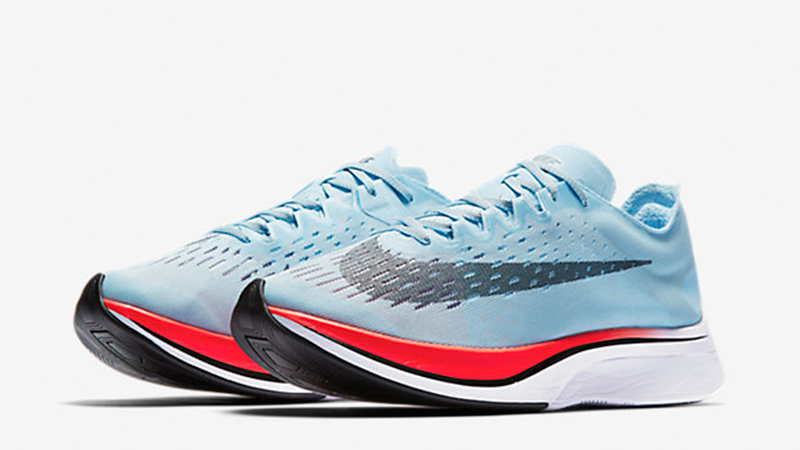
The race was almost like a giant advertisement for Nike’s new shoes: the Vaporfly 4%. *insert people saying "OOOOO AHHHHHH"* These new shoes, debuted by Kipchoge in the race, were said to make you 4% faster. 4%!!!! That might not seem like a huge difference, but in the long run (haha, see what I did there? Didn't like my dad joke? I'm sorry, I won't do it again) it changes things dramatically. Of course, breaking the world record by over 2 minutes is reason to believe that these shoes give you a slight advantage. But one person is not enough.

The 4%'s themselves. Woah. (source)

A study from CU Boulder recently came out to see how and why the shoes makes runners faster. The shoe has a unique foam, which Nike calls “ZoomX”, which is extra soft, while also being bouncy like a trampoline. Paired with a carbon fiber plate in the midsole, to add extra propulsion and stiffness, it makes a killer combination. In the study itself, several runners were placed on a treadmill and were instructed to run for 5 minutes at a 6 minute-per-mile pace. The runners repeated the trial two more times, once with another racing shoe from Nike, and once with a competitor shoe from Adidas. The study came back to show that while running in the 4%’s, less exertion of muscular torque on the runners’ ankles was required, decreasing the amount of work their calves had to do. Also, the carbon fiber plate made the shoe stiffer and less flexible, allowing for an easier stabilization of the runners’ toe joints. So while the shoe might not make you exactly 4% faster, it certainly does you a few favors while running.

Amazed how Phil Knight's company went from using waffle irons to make track shoes,
 to sponsoring a race that nearly broke the barrier of what was thought to be humanly impossible (source)

This shoe is only the latest in the next big boom of sneaker technology. Since Phil Knight, the founder and former CEO, developed the first Nike shoes, sneaker designers have worked tirelessly to create shoes that make athletes jump higher, run faster, and perform at a higher level. From the development of Air Max—the air bubbles in Nike shoes—to the latest Adidas Ultra Boosts, sneakers have always been adapting. But with the newest introduction to Nike’s lengthy history of pushing boundaries, actual biomechanics research and intense studying of the body and foot has been combined to create a product that isn’t just a gimmick. The Vaporfly 4% has shown us just a glimpse of what we can do when we combine sneaker culture and biotechnology research. Since the release of the Vaporfly 4%, running companies, including Nike itself, have upped their games and released sneakers that are mimicking a lot of the features and ideas behind the research that went into developing the 4%. Even basketball shoes have become more advanced! (Click here for more on this) Hopefully some day we get shoes that help us fly, because hey, you never know!

Before we gain the ability to fly with our shoes, Nike has blessed us with shoes that might....wait for it....make you EVEN FASTER!!! If you want to check it out, click here.

Monday, May 27, 2019

Can You Handle The Heat?

I love spicy food, and I've always wondered why some people can tolerate spicy food while others can't. You know that painful burning sensation that comes with the consumption of spicy food?


That feeling like your mouth is on fire comes from compounds known as capsaicinoids, or simply, capsaicin. Capsaicinoids interact with a special protein known as TRPV1 located on nerve cells' surfaces. Usually this protein is activated by physical heat that would signal the brain to respond to dangerously high temperatures. Thus, when capsaicinoids interact with TRPV1 they are sending the same signal to the brain, despite there being no actual physical heat present. The receptors that capsaicin bind to are not only found in your mouth, but all over your body! This is why after touching a hot pepper, you don't want to touch your eyes. Also, pepper spray, also known as capsicum spray, uses capsicum extracted from chili peppers as an active ingredient.


Many people seek this burning sensation, even crave it. This is a result of how our brains work- capsaicinoids trick the brain. Capsaicinoids produce neurotransmitters, one of which is Substance P that transmits pain. The brain responds to this pain signal by releasing endorphins, your body's natural way of relieving pain (dopamine is also released, the chemical responsible for the sensation of reward and happiness). All these endorphins released cause one to experience a sense of euphoria that many describe to be similar to a "runner's high".

You also may be wondering, is it possible to build your tolerance to spice? Yes! Essentially, you have to consume more spice to get your body used to the feeling/sensation capsaicin produces. TRPV1 regulates the feeling that capsaicin produces and lowers the amount of energy that causes the receptors to activate (causing the painful feeling), but continuous exposure will desensitize the nerve endings.

So the next time you open that bag of Takis, don't be afraid of that painful burning sensation, just remember that you're building up your endurance and spice tolerance-what doesn't kill you makes you stronger!

Everlasting Amnesia

Imagine the feeling when a word is on the tip of your tongue but you can not say it. Imagine knowing what to say but you cannot verbalize it. Now imagine having these feelings twenty four hours a day seven days a week for the rest of your life and it only gets progressively worse. This is what it is like living with a rare form of aphasia called semantic progressive aphasia.

The struggle a person with svPPA goes through to communicate their desires. 


Semantic variable progressive aphasia (svPPA) is categorized as a type of frontotemporal dementia (FTD). These types of diseases are holistically due to the progressive loss of nerve cells in either the brain's frontal or temporal lobes. More specifically svPPA affects a person's cognitive skills. This disease dramatically affects reading, writing, speech and processing skills.

Diagram displaying areas of the brain where FTD and svPPA are present.
svPPA is a neurodegenerative disease but it is not hereditary. Symptoms of the disease include anomia, reduced word comprehension, impaired recollection or memory, dyslexia or dysgraphia, and reduced speech production. As stated previously svPPA is a progressive disease which means the symptoms get progressively worse. It initially starts as a language disorder but can progress to also include behavioral, social, and/or motor issues.

Semantic variable progressive aphasia is traced to the temporal lobe. The temporal lobe is the part of the brain that is responsible for speech and language. svPPA is caused by the build up of TDP-43, a protein on the temporal lobe. TDP-43 is built under normal conditions and it is currently unknown why it forms in large amounts in a certain area of the brain. TDP-43 buildup in high amounts in brain cells in the temporal lobe cause those cells die, which then causes the temporal lobe to shrink.

An experiment showing where svPPA is present in the brain.
I was born at the end of 2001 and in my seventeen years the science field advancements have been unprecedented like the Human Genome Project which was completed in 2003. Despite the strides the science community has taken there is still major work to be done, especially in the field of neurodegenerative diseases. This means that there is no cure for Semantic Progressive Aphasia or any type of Aphasia. As of right now anyone with svPPA will never be the same as the day before... the progression is inevitable. This inevitability means that as of right now there are no successful medications to slow the progression.

Diseases like Alzheimer's and aphasia are often portrayed in movies, tv shows and commercials but it never occurred to me that one of my family members would ever be affected by such a thing. My grandmother was diagnosed with svPPA two years ago, but her neurologist felt she was in the middle stages of the disease. My immediate reaction was "at least it is not dementia." I was obviously misinformed. These horrible diseases should not be compared as both rob people of what seem like the most basic skills.

My grandmother, Gigi, can sometimes be hard to deal with and can maybe be a little bit of a curmudgeon but everyone has their flaws. She is loving, funny, and caring, amongst other great qualities. Gigi and my grandfather moved to Florida about 30 years ago which means I only see them a couple times a year but this does not stop me or my fellow family members from remaining in constant communication with them. Weekly phone calls and texts were the forms of communication. Talking to my grandmother has become a lot harder but even more important since her diagnosis. Aphasia has made our conversations turn from complex and enthusiastic to basic and elementary. This does not mean that I enjoy our conversation any less it just means that our talks mostly center around the weather and what I have been up to. While I enjoy talking to my grandmother, it is very different. I worry that eventually I will hang up the phone and that will be the last time she will ever be able to talk to me.

The simplest things like ironing (which my grandmother used to love), texting, or writing out a check have become burdensome and frustrating because of svPPA. There is no way to prevent the disease and no way to stop it. The only thing to do is to spend as much time talking to my grandmother as possible.

Seeing Sound and Tasting Words

What is synesthesia? 
Period 1 of A.P. Bio would be largely silent if not for the piercing conversation coming from table 2. Myself, Eliza Cant, Jake Shapiro, and Laura Kazdoba (plus Ciunga for the start of the year) always seem to find something new to argue about at a convenient 7:30 in the morning. One of my favorite debates happened in mid-January. Having color-coordinated my folders for the year, all my science supplies are an earnest shade of green. Laura found great issue with this as to her, science is blue and nothing else. Jake and Eliza, however, agreed with me that science is clearly a green subject, and that Laura did not have enough coffee that morning to make a genuine argument. I thought the debate would have ended there, but no - other classmates began chiming in with what color they believed science to be. Purple, brown, blue, and even chartreuse popped up from different corners of the room. The situation only diffused when Ms. Eckert interrupted our squabbling with signal transduction pathways and a much-dreaded do-now.

So why am I telling you this story? Well, this incident involved a phenomenon known as synesthesia, wherein one sense is perceived along with another. In other words, something you may see or understand, such as a science, causes a specific color to pop up in your brain. Or, for instance, a particular object is associated with a certain taste for you, one it may not necessarily produce. The fact is that this joint perception is completely unconscious and combines multiple sensory cognitive pathways.
An example of what someone with 
grapheme-color synesthesia may visualize. 

What causes synesthesia?
The good news is, we've all got some form of synesthesia! Just like my classmates associating different subjects with different colors, you, dear reader, most likely visualize one concept along with another, separate sense. The bad news is, scientists aren't exactly sure what causes synesthesia.

Simon Baron-Cohen, a prominent psychologist at the University of Cambridge, has proposed that synesthesia stems from an overabundance of neural connections. In the brain of a non-synesthete (person without synesthesia), each sense is designated to a specific module of the brain. However, a person with synesthesia lacks this separation, leading to increased cross-communication along modules in response to stimuli.

A similar hypothesis is that of cross-activation, suggested by neuroscience professors at the University of San Diego. This theory insinuates that synesthesia is the result of certain synaptic connections not being degraded throughout a person's development, causing increased connectivity between two areas of the brain. Some cite grapheme-color synesthesia as evidence of this theory, a form of synesthesia where specific numbers or letters register as having a certain color. Scientists have observed heightened interactions between the grapheme recognition area of the brain and visual cortex when synesthetes visualize and identify a letter's color, indicating cross-activation.
Cross-Activation: Grapheme and V4 Area

The Bigger Picture
Synesthesia can be an incredibly wonderful thing to have. It allows people to perceive the world in an entirely different way than those around them, and experience unique sensations on a daily basis. Having chromesthesia, an offshoot of synesthesia that causes people to see colors when hearing sound, has had an undoubtedly positive impact on my life as a musician. Some have been able to translate their synesthesia into literal works of art as a means of communicating their experiences to others. For instance, artist Melissa McCracken creates paintings of the colors listening to her favorite songs conjure. Not to mention, many figures in pop culture have synesthesia, ranging from the likes of Billy Joel to Marilyn Monroe. So the next time you hear a certain piece of music or look at a particular string of numbers, be on the look out for whatever colors or scents pop into your head. Who knows? Perhaps you're a synestheste too.

 "Julia" by Melissa McCracken
What the artist visualizes when listening to "Julia" by John Lennon

The Arctic Animal Rumble 2019™


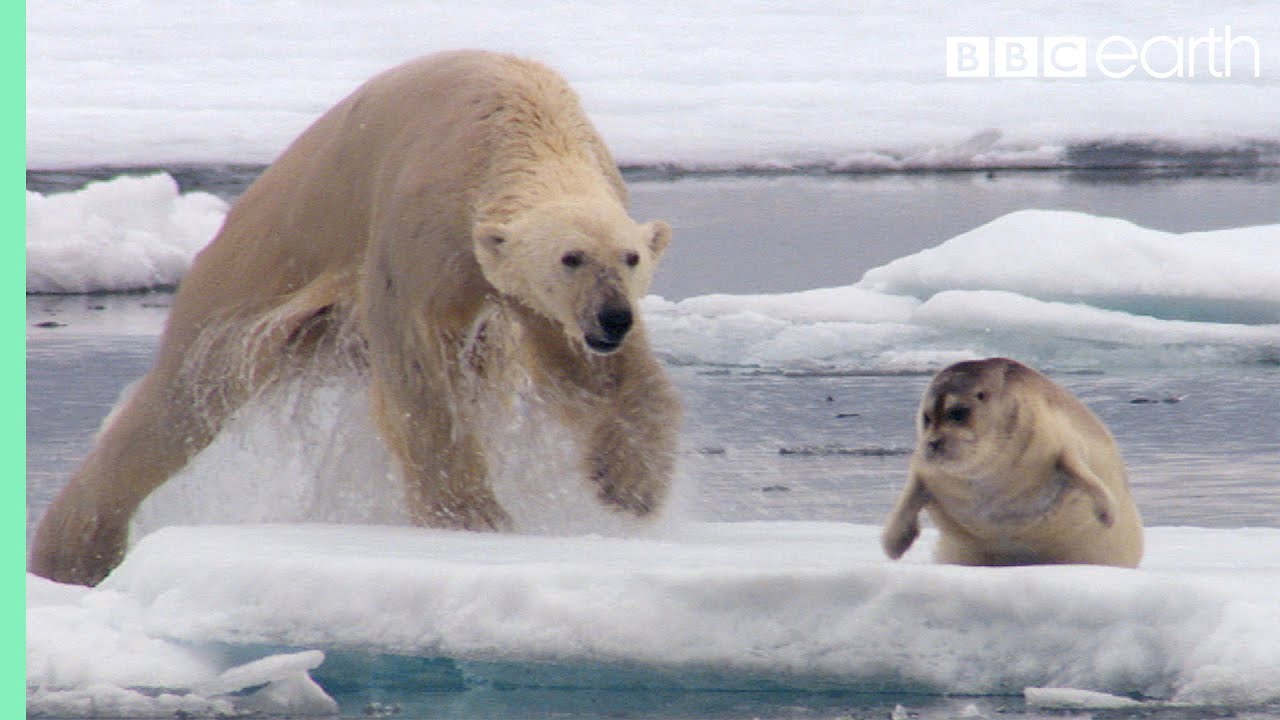
Figure 1: A polar bear ambushing a no doubt terrified seal
If one of every animal in the arctic tundra fought each other, who would win?

A ridiculous question to be sure, but one I find rather intriguing nevertheless. Evolution has always been my favorite part of biology, and more specifically what traits and features animals evolve to survive in their respective habitats, so when this question first popped into my mind I could not help but find the answer. To answer this extremely pressing issue, I did some research on each species indigenous to the arctic tundra biome and what traits they have evolved over time to survive in their natural habit. 

Before I can get into how these animals stack up though, I must put forth a few rules: 

First, there will be no aquatic creatures participating in this fight, as to get to them the non-aquatic creatures would have to go into the water, most likely putting themselves at a serious disadvantage (so sorry to all you orca and narwhal fans). I will however, be including animals that can survive on both land and water such as seals. Second, I will assume that all the animals in this scenario understand that there can only be one survivor, and they are willing to kill to survive; this way animals are able to attack others outside of their typical diet. Third, the setting will be a mostly snowy flatland with patches of dirt and small hills, to provide a fairly balanced playing field, while still giving the arctic animals the ability to use the familiar territory to their advantage. Fourth, each animal will be a fully grown adult, as to keep things fair, and there will only be one of each animal.

And with the rules out of the way we can finally get into how these animals would stack up in a battle royale type scenario. Let the fight begin!

Animals that would die right off the bat:

Figure 2: A snowshoe hare
As many of the animals participating in this fight are either herbivores or primarily eat insects and crustaceans, there are a lot of contenders that can be ruled out pretty easily as a clear loser. The Arctic hare, horned puffin, ringed seal, snowshoe hare, and tundra shrew are all examples of animals that stand no chance against the larger predators of the arctic. While many of these animals are fast can could easily outrun a predator such as a polar bear or wolf, they stand no chance in this fight because of their diet and how that has effected their evolutionary path. Snowshoe hares for example, are herbivores, and as such they have no claws, no powerful bite, no substantial attack mechanism whatsoever. They do however, have especially large feet used to traverse the snowy arctic floor and outrun predators that they would other words be outmatched by. Because there can only be one survivor in this scenario though, running away isn't a winning tactic.

Animals that are unlikely to win:


With the obvious losing contestants out of the way, we can get into the animals that are still going to lose, but are interesting to talk about nonetheless. 

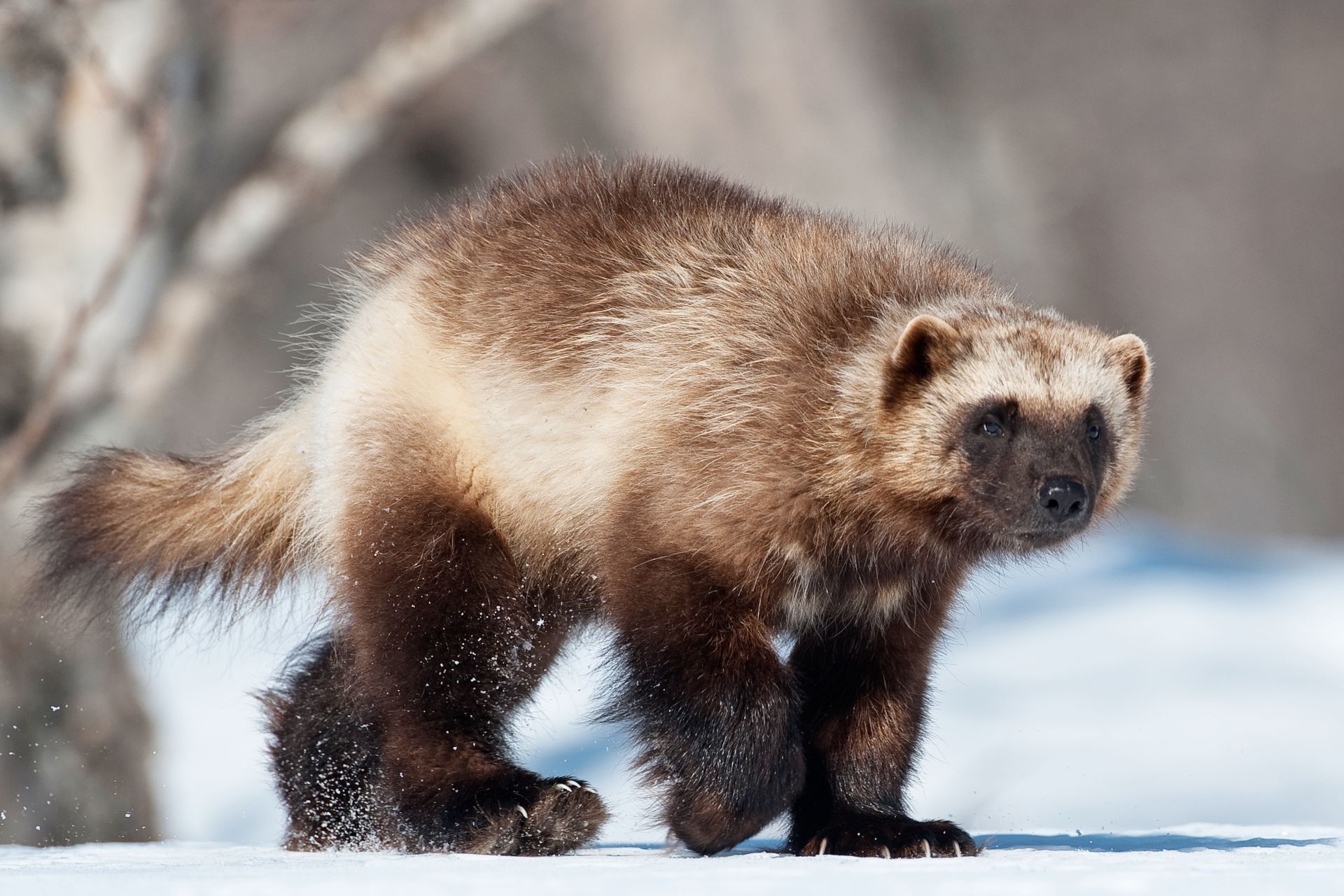
Figure 3: A wolverine
Wolverines have wide, webbed feet to help them cross deep snow without being slowed, and sharp claws to kill their prey; Though a wolverine's most powerful asset is its aggressive nature. Wolverines are some of the most aggressive creatures in the arctic, and often use this to scare off larger predators from taking their food. However scary they may be though, it is mostly just for show. Wolverines are much smaller and weaker than the top predators in the arctic, so to compensate for this they have developed an aggressive nature, allowing them to take on animals much larger than themselves. But while they are able to hold their own against bears and moose, they are not strong enough to actually take them down. Wolverines have been known to kill injured moose and deer, but if any healthy predator were to hold their ground, against the wolverine, it would be unlikely to win that fight.

Being smaller and bulkier than the average gray wolf, arctic wolves are fairly formidable foes capable of taking down larger animals such as caribou and muskox. However, their greatest strength is in numbers, and only one of them is allowed to fight. Arctic wolves typically hunt in packs of three to four, this way they are able to surround and overwhelm their prey, but on their own they are too weak to do a considerable amount of damage before taking a fatal blow.
Figure 4: An arctic wolf

Contenders for first place:
Now we get into the animals that actually have a considerable chance of winning. These animals are not only strong enough to kill most other animals that pose a threat to them, but are bulky enough to take few hits and keep going.

Figure 5: A muskox
Despite being herbivores as many of the animals in the "will immediately die" category were, muskoxen are incredibly powerful and resilient. Their hooves are strong enough to break through solid ice, and when threatened they can charge at a target with incredible force. However like the arctic wolf, their best defense is their ability to protect one another by traveling in groups, and on top of that, they are typically very slow, easily outpaced by most other arctic animals. And for these reasons, I do not believe they could outmatch the other two animals to come.

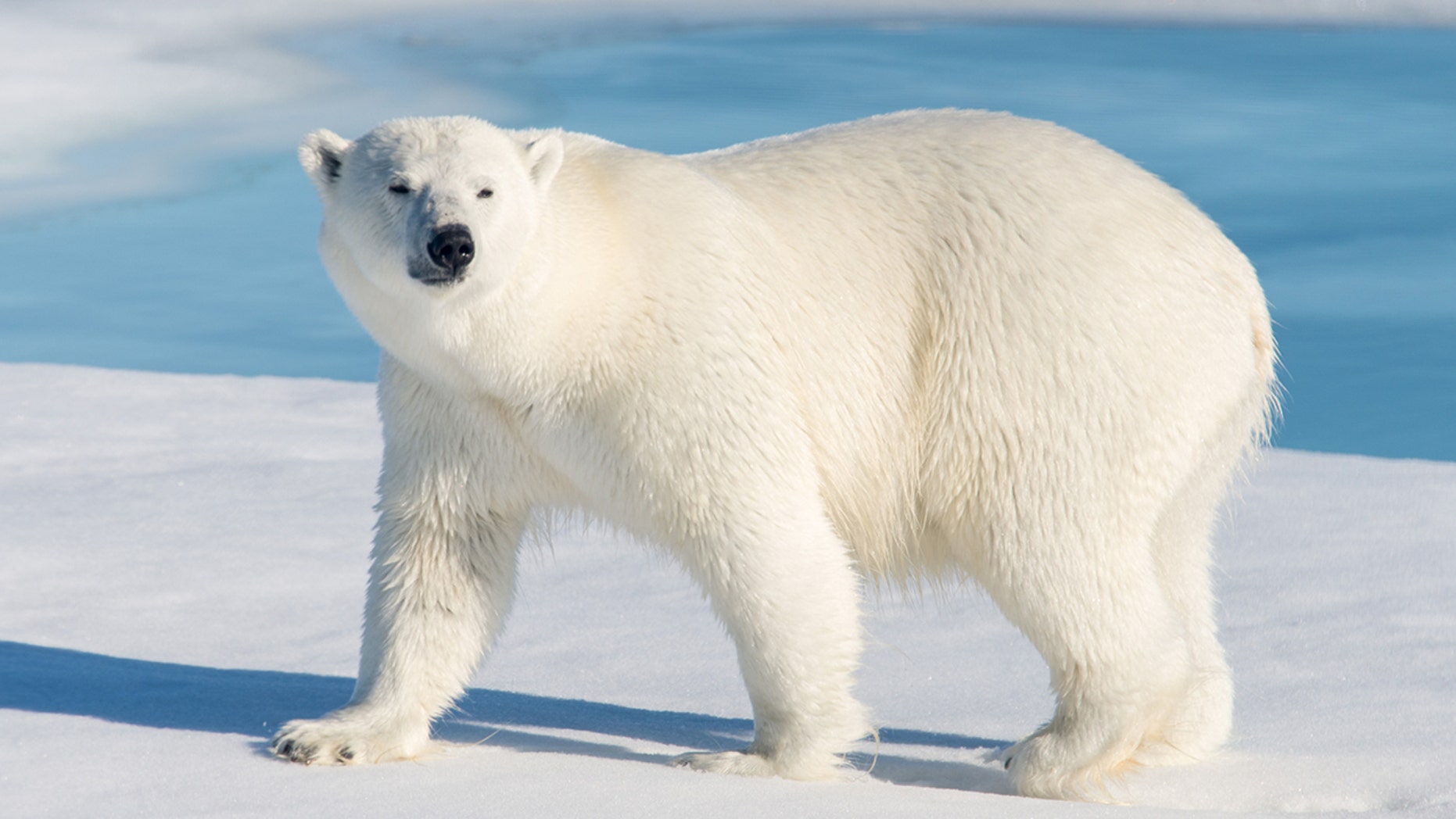
Figure 6: A polar bear
Polar bears were probably the first animal you thought of when you first started reading this post, and for good reason. With powerful claws and a bite force of 1200 pounds per square inch, polar bears seem to be the clear winner in this scenario. However, they do have some glaring flaws. Their top speed is about 18 mph, but they tire quickly due to their insulating fur (although without it they would in the arctic's low temperatures). Furthermore they are significantly less powerful against animals with a body mass equal to or greater than their's.

The most likely winner of The Arctic Animal Rumble 2019™:

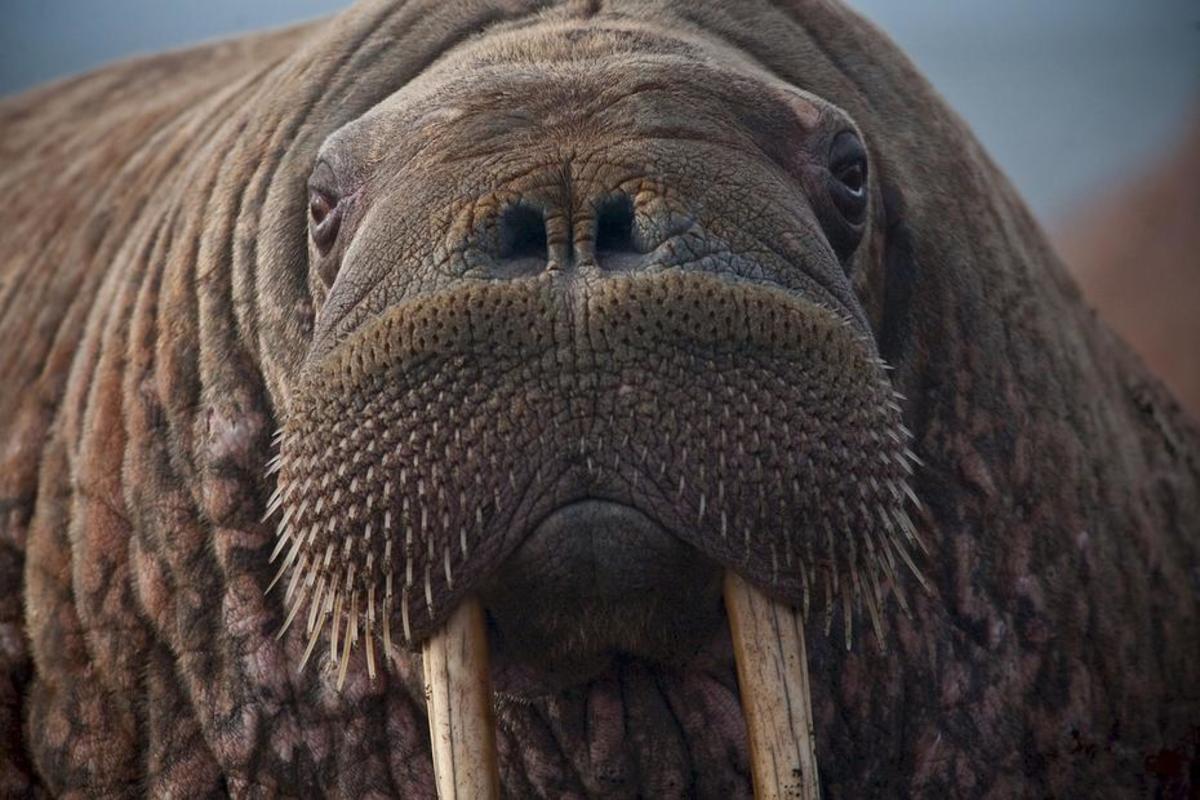
Figure 7: A walrus
Yes, the most powerful animal in the arctic isn't a giant woolly ox, or a killer bear, it's two tons of blubber with big teeth. Walrus tusks are extremely deadly, and just one or two hits can be enough to seriously injure any animal, and in addition to keeping them warm in the cold arctic terrain, their blubber is extremely tough, making even swipes from a polar bear laughably futile. And while they are not particularly fast, they are capable of short bursts of movement upwards of 20 mph, though with their thick blubber they have no need to move, all they would need to do to win is sit around and bite any animal that dare come close enough. And that is why walrus's are the strongest animal in the arctic tundra.