Wednesday, May 24, 2017

Myth-Busters: The Human Brain

Myth-busters: The Human Brain

I would like you to take a moment, and imagine a man, we'll call him Peter, who is sitting on his couch mindlessly watching television--a diet soda in one hand, the remote in the other, and an oversized bag of chips in his lap. Can you picture it? How much of his brain do you think he is actually using? If you said little to none, you are dead wrong. Peter needs to activate several areas of his brain in order to watch television, eat, and even breathe! 


The human brain: one of the most fascinating wonders that is still leaving scientist scratching their heads. Consisting of over 100 billion neurons, the brain is responsible for just about everything we experience in our lives, and it plays a major role in keeping us alive. For example, our cerebral cortex is what allows us to be able to perform higher level thinking, and our brain stem is responsible for our involuntary functions, such as breathing. Unfortunately, there is a myth that still exists that claims that humans only use about 10% of their brain. The myth originated long ago from an unknown source, and has been lingering ever since. The myth made a reappearance on a movie called Lucy, where they claim that humans only use 10% of their brain, and if they were able to control their entire brain, they would have supernatural powers. I'm here to explain to you why that is simply one of the most outrageous claims ever made.

This image shows the complexity of neurons in the human brain
First off, the human brain weighs about 3 pounds, which makes up roughly only 2.5% of an average person's normal mass. That being said, the human brain also uses nearly 20% of our calories to function. These calories serve as energy for the neurons in the brain to be able to function. Now, with all of this information in mind, why would such a large chunk of our calories go towards an organ that only uses 10% of itself? In terms of conserving energy, it would not make sense for the body to exert so much energy on an organ that is hardly put to use. 

Secondly, there is very convincing scientific evidence that much of the brain is being used all the time. Tests such as MRAs (magnetic resonance angiography) can be used to prove that much of the brain is being used at all times. MRAs accomplish this by providing images of blood vessels to the brain. This is important because when a certain area of the brain is being used, blood is supplied to that area. It has been shown time and time again, using these magnetic resonance tests, that many areas of the brain are being used at the same time, well over 10%. 

This is an image of an MRA of the human brain
On the other hand, we also do not use all of our brain at the same time. If every neuron in the brain was firing at the same time, too much information would be processed and your brain would seize. The actual percentage of how much of our brain we use varies, depending on the situation. For example, if we feel threatened, we use more of our brain, and more blood is transported to certain areas of the brain in order to be able to process more information. 

So as for the myth that we only use 10% of our brain: BUSTED

Not as Sweet as You May Think

Many think of sugar as their best friend, something sweet, yummy, and always there for you. I know I do. But this edible happiness is proving to be an enemy. Sugar consumption in the United States continues to increase due to various reasons, some of which include the easy, available processed foods that dominant the food markets. Sugar has been an extremely hot topic in the news lately because sugar lobbyists are trying to protect big sugar companies by attempting to limit the amount of knowledge given to the public, such as a healthy daily amount of sugar. On many processed food items, the daily percentage value for sugar is never listed because for many products, the number would be extremely large, due to the immense amount of added sugar. Now how can something be so bad, when it tastes just so darn good? Sugary beverages and foods, many times, do not contain a great amount of fiber. Fiber takes a longer time to be digested and makes you feel full for longer. When a person drinks a soda, however, with large amounts of sugar in it, this will cause their blood-sugar levels to rise. This then stimulates the pancreas to produce insulin which allows the sugar to be taken from the blood into the liver. When this occurs, the sugar is processed and converted into glycogen, glucose storage for later use, and fat. More fibrous foods allow for the necessary glucose to be absorbed and the rest excreted, while sugary foods lead to more production of fat by the liver.

The fats that are created by the liver, as a result of sugar consumption, are called triglycerides. When too much sugar is eaten and there is a great increase in triglyceride production, this can cause the amount of good cholesterol or HDL cholesterol to diminish in body. These higher levels of triglycerides in the blood and reduced levels of HDL cholesterol can have negative effects on a person's health and is a major contributor to heart disease.
How insulin is produced and used in the body
 
Vs.
Snack comparison (fibrous vs. sugary)
In recent years there has been a greater push toward fat-free foods because of the ideas that foods containing lower fat content would help to decrease weight gain. Seems logical enough, however, after foods started to transition to more fat-free or reduced-fat products, there was actually a rise in obesity and weight gain among many. Fat adds flavor, and when this flavor was taken out it left the food ideas bland and boring. To make up for this, food companies decided to add sugar in many cases to bring back the flavor into their items. These increased sugar levels therefore lead to greater amounts of weight gain.
This documentary goes more in depth.

Sugar can greatly affect health aspects of a persons' life. Too much sugar can lead to obesity, heart disease, diabetes, and much more. While too little sugar than blood glucose levels may be too low and affect brain activity. Glucose is needed to help promote brain activity. Sugar is even thought by many researches to be addictive or have addictive affects. It is not known for sure, however, when a person eats sugar dopamine, a neurotransmitter in the brain, is released, similar to alcohol or other drugs. This is different because in the case of sugar, the release of dopamine is not as severe. When sugar is continuously eaten dopamine levels that are produced are not lowered or decreased after many consecutive consumption, like more foods are. This is why people may crave sugar or not get tired of eating sugary foods because it makes you feel so good.

Sugar craving
After reading this you may be thinking that sugar is a scary thing. In moderation, sugar can be good and acceptable, as long as you know to keep it in control. It is important to know that while sugar may not be so good for you, the alternative, fake sugars are not a better option and in many cases may be worse. Artificial sweeteners may deter many from real sugar options, and it is always better to consume the real deal, rather than something unknown. Diet kind may not actually be helping anyone.

Examples of common artificial sweeteners used
We can all admit that sugar is a wonderful thing. It is used to make so many wonderful things, dessert, candy, chocolate (yummm), but we have to keep in mind some of it s negative effects. Natural sugar is always a better option as well. You may being thinking, how is sugar from fruit any better compared to other kinds of sugar? The truth is that your body cannot tell the difference between the different kinds of sugar (sucrose, fructose) sugar is sugar, but fruit is different because it also contains many good components along with the sugar.  Fruit has fiber, making it a healthier option, so if you are ever in need of something sweet, try an apple :)
Decisions, Decisions...

Why Does This Jacket Smell Like Childhood??!!

You are packing again for summer camp, and frantically searching for the huge suitcase reserved for these two week long excursions. After finally spotting it in a dusty corner of your basement, you lug the giant purple suitcase up two flights of stairs and into your room. Finally ready to start packing, you unzip the suitcase and whip open the cover. With one inhale, everything from last summer at camp comes rushing back--you remember the cabin chats, the ropes courses, the friends you made, and the s'mores you roasted. Woah. Your first thought is excitement and longing to return to camp, followed by confusion as to what just happened. Was it magic? Was it the universe telling you that you will have a great time at camp? The answers to both of these questions is no. This experience was purely driven by science.

A Thought That Must Be Going Through Your Head Right Now

To begin explaining this incredible phenomenon, we must first understand brain anatomy. When a smell enters the body through the nostrils as odorant molecules, the molecules dissolve into the mucus in the nasal cavity and bind to a receptor with a socket perfectly shaped to fit the molecule. This all happens in the cilia of dendrites located on bipolar neurons. The attachment of the odorant molecule results in action potentials that navigate the olfactory bulbs on their way to the thalamus, the limbic system, and lastly to the temporal lobes where the scent is interpreted and integrated. To better understand neuron structure and function, click here.


Diagram of the Nasal Cavity and Olfactory Bulb

The olfactory bulb extends from the nose to the bottom of the brain. It directly connects to the amygdala and hippocampus. The hippocampus is the place where short-term memories are stored, and the amygdala is responsible for the production of moods and emotions. Like peanut butter and jelly, these two parts of the brain work together to produce something magnificent--memories and emotions generated solely from smell. Scent is very unique when it enters the brain because it is one of the only senses that has connections to the hippocampus and amygdala. Auditory, tactile, and visual information do not pass through these parts of the brain. Taste functions in a similar manner as smell, given that the taste cortex (takes in and processes taste) is connected to the hippocampus.

 Diagram of the Regions of the Brain Involved in Interpreting Olfactory Information

Intrigued and curious about this process, I decided to conduct an experiment using my peers as guinea pigs. I covered one cotton ball with CVS Kids Clear Spray Sunscreen, and another with CVS Baby Powder. I asked every participant to close their eyes, smell the cotton balls one at a time, and immediately write down what came to mind when smelling the scents. 

The best part of this investigation was seeing the incredible reactions each participant had to the scents. I counted every instance a classmate mentioned a certain memory, so these numbers do not add up to the total number of people interviewed. For the sunscreen, seven out of the twenty people participating said that the scent brought them back to the beach, six said it reminded them of a particular summer day, three of them remembered their childhood, and five had other, abstract experiences. These results were exactly as I expected, given that this type of sunscreen is primarily used in the summer, at the beach, and during childhood. 
CVS Kids Clear Spray Sunscreen

The baby powder, on the other hand, did not reap the results I expected. The reason for this is primarily my fault for not using baby oil instead (it soaks into the cotton ball more easily) but also the participants' faults for breathing too hard and inhaling all of the powder. Only two of the twenty interviewees were reminded of an experience with babies, four remembered childhood, nine felt nothing, three were brought back to a sweet time baking or sniffing sugarcane, three remembered doing laundry, and two had other, very different experiences.


CVS Baby Powder

In the end, after awkwardly asking strangers to smell my mysterious scents, the beauty of the human brain is majestically evident. It is unbelievable how simple molecules can trigger memories thought to be long forgotten.

Super helpful and awesome links!!!:


The Way I See It

Visual Perception Theory

Take a look!


Look closely at the image above. What do you see? Does the picture appear to be moving from side to side? Take a minute to think about why your perception of this image might not match the reality of what is actually there. . .

What is visual perception?

Visual perception is the process of recognizing and interpreting visual information around us from sensory stimuli. The human eye receives stimuli in the form of light. Next, the eye sends the stimuli to the brain, so the signals can be interpreted into physical images. This is a process of the central nervous system.


Perception vs. Reality

To properly understand visual perception, it is necessary to first understand the difference between perception and reality. Perception is our "recognition and interpretation of sensory information," including the human response to the information. The key word in this definition is interpretation, because this is where perception and reality differ. It is possible for a person to see something that is not actually there, like a hallucination or illusion. The person is not necessarily wrong about what they are seeing, but it is not reality. The illusion is the person's individual perception of reality.


Processes in Perception

There are two main processes said to be involved in perception. The first is bottom-up processing, and the second is top-down processing. In bottom-up processing, perception is initiated by the stimulus itself; it is mono-directional and each stage in the pathway performs a more in depth analysis of the input than the last. Top-down processing occurs with the use of contextual information in pattern recognition. While there is controversy about which of these processes truly defines perception, a psychologist by the name of Richard Gregory makes a strong argument for top-down processing. He says that perception is a "hypothesis," based on prior knowledge, and it is formed according to our environment and stored information.  Gregory's theory claims that because a lot of information is lost in the pathway between the brain and the eye, the brain has to infer what the eyes are seeing based on past experiences. (To learn more about Gregory's theory, click here).On the contrary, James Gibson says that perception is a singular direct process, and relies on bottom-up processing. He says that there is no interpretation involved perception, and that it can be explained solely in terms of the environment.  (To learn more about Gibson's theory, click here).


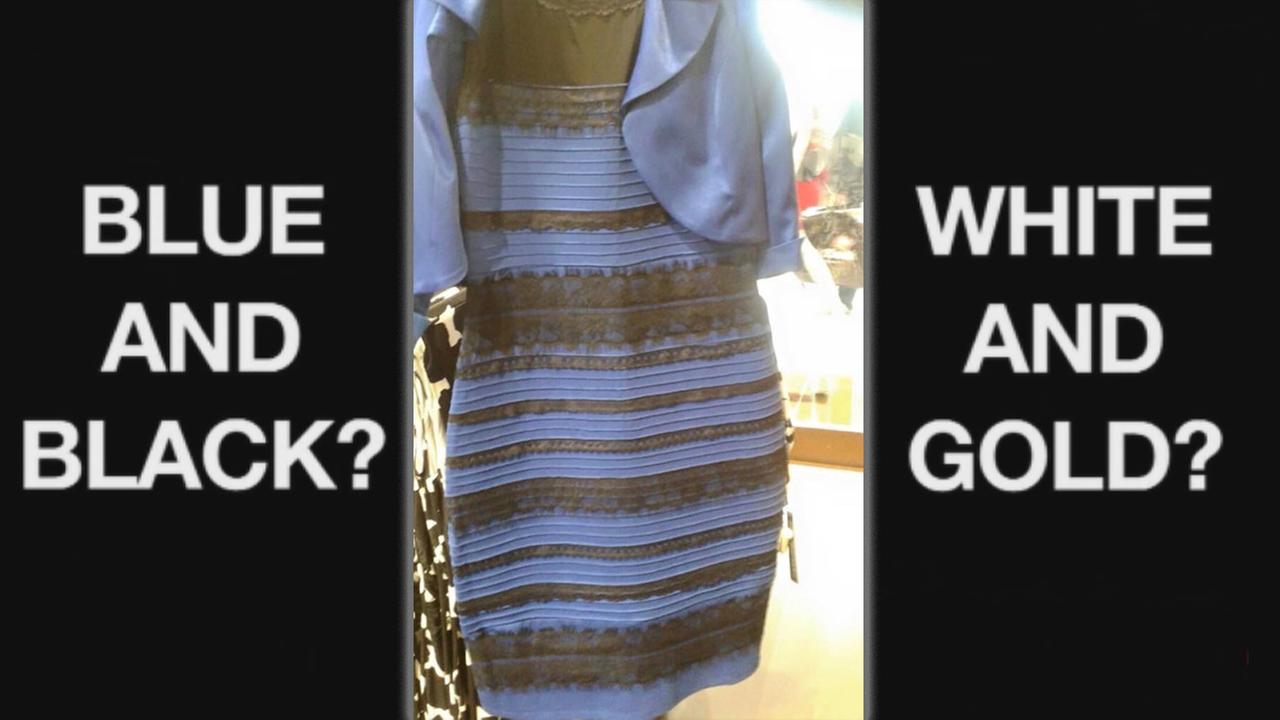
The Dress!

As many of you probably remember, a few years ago there was a photograph of a specific dress circulating the internet. For some people it appeared blue and black, and for others it appeared white and gold. The mass hysteria caused by this photograph left people dying to know the reasoning behind it. Researchers studied the phenomenon and found that it all has to do with the brain's perception of color. In an article from livescience.com, the author says that according to a study performed by neuroscientist Bevil Conway, "the differences in color perception are probably due to assumptions the brain makes about the illumination of the garment so that it will appear the same under different lighting, a property known as color constancy." This explanation aligns more with Gregory's theory of top-down processing, because of the implication that human brains make assumptions that alter perception. For another fascinating explanation, check out this video from ASAP science. "The Dress"phenomenon caused many people to think about the question of whether different people see colors differently, which is a difficult thing to wrap one's head around. The explanation to the experiment and the science behind it left me wanting to know much more about visual perception in general. I find it incredibly interesting how visual perception theory combines both psychology and biology, and while there is still some ambiguity surrounding the topic, I am intrigued to learn what other theories exist.


Cut It Out

Recently, genetic engineering has become the new black. It seems as if everyone these days are genetically engineering organisms in order to benefit themselves and their lifestyles, but what exactly is all the hype about it?

Genetic engineering is the deliberate modification or manipulation of an organism's characteristics by changing its genetic material. This means the original DNA of an organism is altered by either removing or transferring part of its genetic code. Kind of cool when you think about it. This idea was first cultivated by two scientists, Herbert Boyer and Stanley Cohen, who determined that genetic information could be replicated and cleaved from different organisms in order to produce an organism with desirable traits. They specifically focused on plasmids, E. Coli, and resistance to antibiotics, but now people have taken this technology to a whole new level. Genetic engineers have begun to use this type of science to "create" babies, which have become known as designer babies.

The main component that contributes to scientists' ability to alter DNA is the CRISPR gene editing tool. CRISPR is an acronym for clustered regularly interspaced short palindromic repeat; now that is a mouthful. Essentially, this tool changes the sequence of DNA in cells in a precise fashion in order to correct mutations that might otherwise create diseases. CRISPR utilizes the the protein Cas9 as a molecular scalpel for DNA. This protein has the ability to recognize a DNA sequence in a cell that is flawed and can then disable or repair the mutated part of the DNA sequence. Now the only way Cas9 is able to find the malfunction in the DNA is by attaching to the RNA sequence that matches the DNA sequence we are going to edit. We then put this combination of RNA and Cas9 into the cell and it will find the mutant DNA and through a chemical reaction it will cut the DNA strand at the location where it is malfunctioning. After the Cas9 and RNA are inserted into the genome, genetic engineers can then insert the correct version of the gene for the cell to function properly again. 

Oh wow just look at how the Cas9 protein does its thing


Although the CRISPR technology was originally intended for combating diseases, people are exploiting the technology for their own needs. Designer babies have become an increasingly common   concept among many. Having the potential to edit the DNA of cells or the embryo itself could lead to genetic fixes and a way for parents to ensure that their offspring will not have any genetic disorders. For now people are focused on preventing diseases or disorders such as, cystic fibrosis, Alzheimer's, and Down syndrome, but as the technology becomes more effective the more people are willing to do to their babies. Genetic engineering is a dangerous path in which parents will do anything in order to create the child of their dreams. Want a child with blonde hair and blue eyes? What about a child that is highly intelligent? In the near future this all may be possible.

This could be your child if they were genetically engineered

As the idea of genetically engineering organisms progresses, the more controversy it causes. Some believe that designer babies and children that have been genetically engineered propose health risks, are unethical, and only available to those who are rich or can afford it. On the other hand, those in favor believe this gene editing tool can defeat genetic diseases and will help lower the risk of contracting diseases such as HIV or AIDS.

While designer babies are still just a hypothetical scenario it creates a "slippery slope" in regards to the future. Since CRISPR is such a disputed topic it is hard to definitively say when genetic engineering is for medical use or for enhancements. One example where this blurred line comes into play is with kids who are autistic. There is a gene called GRIN2B which is known to be linked with the autistic spectrum. If a child with autism were to be genetically engineered, the GRIN2B protein amount would be increased which could lead to higher cognitive abilities, since these two aspects are connected to one another. As a result, more people are more likely to exploit this technology for personal gain.

In this day and age people will go to great lengths to ensure that they have the next best thing. If this includes designer babies then we will all have to rethink our procreation and how it will affect society as a whole.


Tuesday, May 23, 2017

The Elusive Venus Fly Trap

   A great natural mystery in our world is the case of the carnivorous plant, Dionaea muscipula. Better known by its common name, the Venus Fly Trap. I've always known about their presence. When I was younger, prior to an introduction to biology, I simply accepted that they were plants that with a diet based on trapping flies and digesting them. 
   More specifically Venus Fly Traps capture their prey due to little sensitive "trigger" hairs on the surface of the plant. When a bug lands on the plant, the hairs trigger a response and the two mouth like lobes of leaves snap shut trapping the unlucky fly. The trap constricts the victim excreting digestive juices to break down its food. Similar to how the human stomach works!   to prey was 

 Yet after a long two years dedicated to learning biology, I learned that plants can convert abiotic factors into usable energy making them primary producers.  Through the process of photosynthesis plants convert light energy into usable energy.

  So if plants are capable of producing their own energy from nonliving sources, why do Venus fly traps expend so much seemingly unnecessary energy to consume flies? 

 The answer lies in the environment. Venus Flytraps are native to sandy shrub-boggy areas in North and South Carolina. These areas are prone to frequent fires due to the dryness and heat. The fires clear out many of the competing plants and remove much of the nitrogen from the soil. Nitrogen is a vital nutrient in plants its is a major component of chlorophyll, making it a key ingredient to carry out photosynthesis, and necessary for plants to absorb. As well as a a component of amino acids, the building blocks of proteins. Proteins in plants are plays a role in the structural base for plants, and act as enzymes speeeding up the biochemical reactions that take place in a plant in order to live.With low levels of nitrogen in the soil, Venus Fly Traps must get it from another source, which is where flies come in. Consuming bugs provides the plant with three quarters of their optimal nitrogen supply, making them a key role to their survival. Therefore the extra energy used to trap and consume these flies is well accounted for. Venus Fly Traps still are plants, flies do not provide them with all of the energy that they need to thrive. Photosynthesis takes place in addition to the consumption of flies

   However another question arises, how is it that these plants developed to trap flies and use them as a source of food? Since when do plants become the predators? 

    Evolution is the answer. The trigger hairs that initiate the trapping and breaking down of flies are very similar to how non-carnivorous plants detect and initiate defences against predators. The shared mechanism indicates that overtime, Venus Fly Traps could have evolved from non-carnivorous plants. What distinguishes them is the use their trigger hairs as an offense rather then a defense approach to predators. The prey became the predator and the predator became the prey.
  
   This astounding adaptation shows the fly trap's ability to adapt to changes in the environment, and like everything in biology, they show that most processes in organisms that expend energy happen for a reason.


Garbage in the Oceans: The Plastic Bag on the Side of the Highway


Have you ever walked by a plastic bottle or bag on the street and wondered, "Where will this end up?"

Turtles often mistake debris as food
A gust of wind is all it takes for an empty shopping bag to be the cause of death for an innocent organism. Once the bag is blown into the water ways, it makes its journey into the ocean. The bag is then partially broken down by the sun, but it does not completely degrade. The smaller pieces of plastic usually end up in a gyre. A gyre is a circular rotation of water currents that is the created by wind. The earth has five major gyres. Trash often times ends up in gyres which yield a vortex of debris. The organisms living in the same environment as gyres are greatly affected by the overwhelming amount of invasive debris.


Garbage Accumulated in a Gyre
Currently, there are approximately 5.25 trillion pieces of garbage in the world's oceans. This trash has had a profound effect on sea life and the environment. Although, large pieces of plastic are broken down into smaller pieces, much of this waste cannot be decomposed, and thus, accumulates in the ocean. Often times fish and other aquatic organisms mistake pieces of plastic as food, which can have a life threatening impact on them. Not only does trash accumulate in the ocean and harm life there, it also washes up onto the beaches. This affects the habitat of many birds and turtles, which causes a threat to their environment, and their ability to survive.

It is estimated that in 2050 there will be more pieces of garbage in the ocean than fish, if people continue to pollute the ocean at the same rate in which it is occurring today. The EPA (Environmental Protection Agency) has worked to reduce the amount of pollution that the United States puts into the ocean. Important legislation has been passed that has caused significant gains in debris reduction in the ocean. MPRSA was passed in 1972 and has regulated what can and cannot be dumped into the ocean. It identified the ocean as a place not acceptable for the dumping of certain wastes. In 1988, MPRSA was amended by the Ocean Dumping Ban Act. This forbade the dumping of "medical waste" and industrial waste into the ocean. California passed legislation to help reduce the amount of plastic bags produced. This in turn reduces the amount of plastic bags that will end up in the ocean. The ban on plastic bags means that people will either have to bring reusable bags with them when they shop, or they will have to pay for a paper bag. The United States regulation of waste in the ocean has helped marine life significantly. However, many countries, especially in Asia, do not regulate disposal of garbage in the oceans.

The Ocean Cleanup Trapping Debris from the Ocean

Luckily, there is hope for our oceans. Cleanup programs such as "The Ocean Cleanup" have begun their work to combat the 5 trillion pieces of garbage in the ocean. This program utilizes a passive mechanism that cooperates with the natural current of the gyres to move the trash into systems which will allow the trash to be taken out of the ocean and returned to land. Then what? The program then plans to develop a system in which the debris can be recycled and reused into new products. It is estimated that this program will be able to reduce the amount of debris in the Great Pacific Garbage Patch (the biggest in the world and not too far from our home turf) by 50% in five years.