Friday, May 12, 2017

The Respiratory System: An Incredibly (not so) Easy System That Works for All

The Respiratory System

Breathe in and breathe out. Congratulations you just used your respiratory system, wasn't that really easy? Well it seems that breathing in and out is a simple walk in the park, but is that only what the respiratory system is about, breathing? Contrary to what most people think, the respiratory system is responsible for a multitude of processes in your body. We understand that gas exchange is one process but the respiratory system is also responsible for: communication, olfaction, acid-base balance, blood pressure regulation, blood and lymph flow, and blood filtration. Exactly, the respiratory system is not just gas exchange between oxygen and carbon dioxide!


Figure 1. The Respiratory System


When I was an infant I had tracheal webbing, which made it very difficult for me to breathe. I spent quite a few months in the NICU at the hospital which was not normal. I was being cared for twenty four hours of the day, seven days a week. I was hooked up to what seemed like all the machines in the world. I have had asthma all my life and it has gotten better these past four years of high school.  It has been a while since I have been to my pulmonologist, and every time I would go for a check up, I would be so intrigued by how my doctor explained the respiratory system.

The main organs of the respiratory system-

  • Nose
  • Pharynx 
  • Larynx
  • Trachea
  • Bronchi
  • Lungs

Figure 2. Organs of the Respiratory System


As oxygen is inhaled, it flows through the pharynx and larynx, to the trachea. The oxygen enters the lungs and through the bronchi, and has a final destination of your alveoli. Passing through the bronchi, the air separates into bronchioles which lead to the alveoli. Each of your two lungs has a system of air tubules that branch out forming a bronchial tree. This tree extends from the main bronchus, and into sixty-five thousand bronchiole terminals. At the end of each bronchiole there are alveoli. An alveolus is pouch about 0.2 to 0.5 mm in diameter where the gas exchange between oxygen and carbon dioxide occur. In a human lung, there are approximately 150 million alveoli. That is 300 million alveoli in a human body! Instead of having one big alveolus, we have millions of alveoli. Thus, increasing the surface area to volume ratio, which allows more molecules to diffuse across the cell membranes.  

Figure 3. Alveoli in the lungs


Each and every alveolus is webbed in by blood capillaries stemming out from the pulmonary artery. In-between the air pouch and the capillaries there is a respiratory membrane protecting alveoli with squamous endothelial cells. These cells are very thin, having a total thickness of about 0.5 micro meters. When oxygen is taken in, carbon dioxide is expelled by diffusing through the capillaries and into the alveoli.


Some Disorders of the Respiratory System

Acute rhinitis (common cold): Whether you like it or not, everyone has experienced a common cold before in their lifetime, and yes if it means getting out of work for whatever reason, some people wouldn't mind getting a cold. This sickness is caused by many different types of viruses that infect the upper respiratory tract. Congestion, coughing, and sneezing are all symptoms of acute rhinitis.

Pneumonia: This infection affects the lower respiratory tract. Different viruses, fungi, protozoans, and bacteria lead to alveoli being filled with fluid which interferes with the gas diffusing between the capillaries and the alveoli.


Figure 4. Pneumonia


Not to say that all the other systems of the body are not important, but by highlighting the respiratory system, it allows us to realize how important it is. The respiratory system not only allows us to breathe but is also responsible for many other things. Blood filtration and acid-base balance are just a couple of things the respiratory system is responsible for. At the end of the day, our bodies require oxygen no matter what the case is, our cells need it to live and function to carry out our everyday actions, thoughts, and feelings.

Helpful Links for the Curious Crowd

The Respiratory System Anatomy

Thursday, May 11, 2017

Why You Should Get Rid of Your Lawn

Everyone knows what the lawn in front of a house looks like: an unbroken sea of neatly trimmed, (mostly) green grass. But, did you know that your lawn is not only incredibly wasteful but actively harming the biodiversity of your neighborhood?


What Lawns Do

Realistically, they only show who has enough extra money they can spend it on something completely useless and aesthetic. Some houses, especially larger ones, have perfectly manicured lawns that can cover thousands of square feet, doing nothing beneficial at all to anyone.

Wow! So Useless!
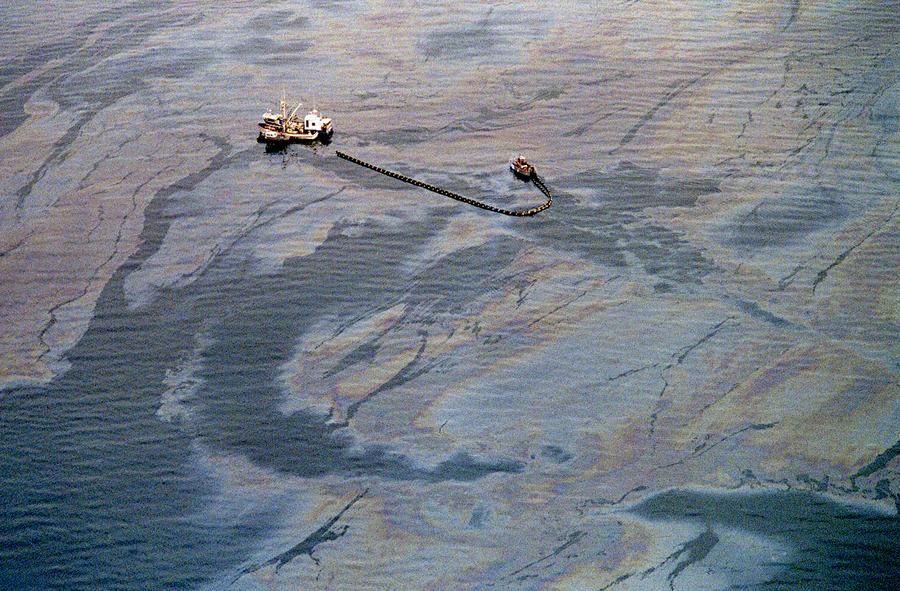
Besides this "function," lawns and lawn care actively harms the environment despite being made of plants and dirt. Grass itself is extremely harmful to the environment especially because it decreases the biodiversity of ecosystems by outcompeting every other plant (with human help, of course). To read more about the scourge on our country that is grass, visit this wonderful blog post written by one of my amazing peers! Lawns also waste horrific amounts of water (over 30% of domestic water consumption), are treated with harmful pesticides and herbicides ("weed killers"), are cut with lawnmowers that cause at least 5% of our country's air pollution whose spilled fuel alone amounts to more oil than the infamous Exxon Valdez spill.


This is less oil than what lawn mowers waste every year

How You Can Help Stop This Tragedy
Have I convinced you to get rid of your lawn yet? Good, because here are some great ways you can convert yours into an ecological paradise. Imagine how cool it will be if we could all produce the food we needed for ourselves and our native species. We'd be saving money while developing a green thumb! 
 
Buy and re-introduce native plants to your yard! Just in case you don't know many off the top of your head, here are some beautiful flowering plants:

Anemonalla thalictroides, pink variety (Pink Rue anemone)
Leonicera sempervirens (Coral Honeysuckle Red)
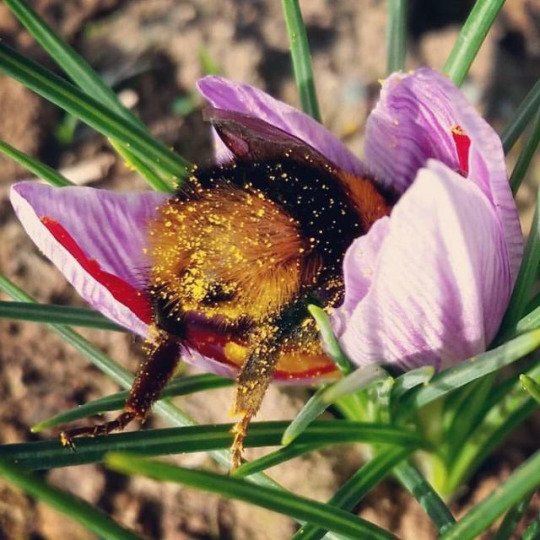
You can find a huge list of more seasonal beauties in this gallery, created by the Native Plant Society of New Jersey. You can even plant specific flowers to attract different animals, such as butterflies or bees!
Who doesn't want some of these guys to hang out with?

Plant seeds of your favorite fruits, veggies, herbs, and spices! This is actually one of the easiest ways to save money in the long run (less grocery shopping).

Please, do the planet (and yourself) a favor and get rid of that nasty homogenous green blob in front of your house.

Teaching Evolution: A History

The teaching of evolution in public schools has long been a controversial issue in the United States. Scientists have long clashed with creationists over presenting unbiased information on the proven scientific fact of the theory of evolution. In this post, I am going to show you a history of how evolution has been taught in schools, and the court cases that helped shape this law

In Darwin's Day

When Charles Darwin published his book, On the Origin of Species, the public response was mixed. Darwin had the unfortunate luck of publishing his book at the same time that a new movement of Evangelist Christianity was spreading through the United States. Prominent evangelist preachers, such as Dwight L. Moody quickly condemned Darwin's text, calling it contrary to the teachings of Bible. Public opinion, particularly in southern states where evangelists were more prevalent, swung generally against teaching this new theory of evolution in schools.

The Butler Act and the Scopes Monkey Trial (1925)

A scene from Inherit the Wind about the Scopes Money Trail
In response to these beliefs, many states created laws that actively prevented the teaching of Evolution in schools. The Butler Act was a Tennessee law passed in 1925 that outlawed public school teachers contradicting in any way the creation story from the bible, as well as teaching that "man is descended from a lower order of animal". This law was eventually challenged by the ACLU, following the arrest of the high school teacher John Scopes under the law. This led to the highly controversial case referred to as the Scopes Monkey Trial. Following days of contentious, incredibly publicized and sensationalized debate, the jury ruled in favor of the law, upholding John Scopes' arrest. The issue of teaching evolution quietly died, with many (mostly southern) states passing similar laws. Evolution, for the most part, would not be taught in public schools for the next 40 years.

Epperson v Arkansas (1968)

Susan Epperson, the brave teacher who
put providing a good education above
her own freedom!


The next time that the issue of teaching of evolution would come back into public view was the Supreme Court case of Epperson v. Arkansas. Susan Epperson was a high school teacher in Arkansas who sued the Arkansas legislature over a law that forbid teachers from teaching evolution, or even from using textbooks that taught evolution. Epperson argued that the Arkansas law limited her First Amendment rights. In a landmark decision, the Supreme Court decided that the Arkansas law violated the Establishment Clause of the Constitution (the part that prevents the government from establishing a state religion). The court decided that, because the law was clearly based on the beliefs of fundamentalist christians, it was unduly helping one particular religious sect, and was therefore unconstitutional.

Edwards v Aguillard (1987)

Pictured: A balance, like the Louisiana law tried to make
between evolution and creationism education in schools
No longer allowed to ban evolution education outright, anti-evolution advocates switched tactics. Now, many conservative groups attempted to chip away at evolution education by instead framing the issue as a controversy between two equally valid ideas: evolution vs. creationism. Now, quite obviously, evolution and creationism are not equal ideas, as one is a scientific argument and one is based in religion. However, by branding the issue like this, anti-evolution advocates sought to get around the decision of Epperson v Arkansas and to allow creationsim to be taught in public schools. This is also where the idea of "Teach the Controversy" comes from, that schools should present 'both sides' of this 'controversial' issue, and allow students to decide for themselves. This is problematic in the case of evolution, as 'teaching the controversy' presents the two ideas as equally scientifically valid, and promotes the teaching of religious principles in public schools.

This rebranding led to the creation of a Louisiana law, the "Balanced Treatment for Creation Science and Evolution Science in Schools Act", that prohibited the teaching of evolution in public schools, unless such teaching was accompanied by teaching of 'creation science' along side it. The Supreme Court ultimately saw through this rebranding, stating that the law was clearly in violation of the establishment clause, as it required teachers to teach creationism, a religious doctrine, in public schools.

Kiltzmeier v Dover Area School District (2005)

Anti-evolution advocates were stuck. They wanted creationism taught in schools, but had no way of getting around the pesky separation of Church and State. The answer came in the form of a new phrase, fresh off the presses of the conservative think tank the Discovery Institute: Intelligent Design (ID). ID, in essence, is creationism hiding as pseudoscience. A textbook, Of Pandas and People, was quickly written by creation scientist Percival Davis, presenting a number of pseudoscientific justifications for the idea that many things in nature show signs of being far too complex to have occurred naturally, and instead could only have been designed by some sort of creator. These ideas, of course, can be directly debunked by any evolutionary scientist. ID was a clever tactic, which built off of the ideas defeated in Edwards v Aguillard by presenting a debate between the 'equally valid', now both scientific ideas of evolution vs. intelligent design.

A lawsuit appeared in the Dover Area School District, after school district officials required teachers to read a statement about how ID was a logical, scientific alternative to the theory of evolution which the statement described as having holes and flaws. The case came before a federal judge who, over several days, took testimony from both biologists and creation scientists. In the end, the judge decided that ID was pointedly NOT SCIENCE, and that it was merely another attempt to allow creationism to be taught in public schools.
A pseudoscientific textbook that teaches intelligent design

The Story Today


Today, two states have laws on the books that permit creationism to be taught in public schools. Despite the years of drawn out legal battles, evolution is not taught everywhere throughout the United States. Even beyond the legal battles, there is not any good way to tell what is actually being taught in science classes throughout this country. Many schools probably continue to flaunt settled law to push religious arguments on students in public schools. Because of these issues of education, many adults in this country still refuse to accept the undeniable scientific truth that is Evolution. As laws change, and as our society progresses, hopefully our evolution education can improve. As our education improves, perhaps our societal views on evolution will start to improve as well.

For more info check out:
  • This more in-depth timeline of the history of evolution education in this country!
  • This article from the NCSE on evolution education!
  • This pew research article on the current laws on evolution education, state by state.


Mnemiopsis: Disco Balls of the Deep

Today, I’m gonna tell you guys about…. Walnuts (of the sea)!!! Although you may think I’m going to write a post about a nut, I’m actually talking about is a really cool kind of comb jelly (or Mnemiopsis as the nerds call them).
File:Sea walnut, Boston Aquarium.jpg
Mnemiopsis Jellyfish. Look at these guys!

These cool jellies are a species of comb jelly that originally come from the Western Atlantic sea. It can survive in a large range of salinity of water, and a wide range of temperatures.  It is not very mobile, and its slow movement speed, as well as its oval shape, is what earned it the name “Sea Walnut”. The body of the Mnemiopsis is fairly small, with the largest jellyfish rarely exceeding a length of 12 centimetres.  They are not stinging jellyfish (so no reason to be scared!) and they are actually hermaphroditic, so they can self-fertilize when reproducing.

These comb jellies may not look too intimidating, but they are major carnivores! They feed on zooplankton, fish eggs, and other smaller comb jellies (ewww). One major problem they cause is their categorization as an invasive species. In the 1980s, they were transported from the west atlantic to the black sea by ship’s water ballasts. This caused them to multiply too quickly, and outcompete other organisms in the ecosystem. Although they look cool, they are a real bother!

You’ve learned some pretty cool stuff about Mnemiopsis so far, right? This is some pretty cool information!


...But I know what you all really wanna know.


WHAT IS THAT COOL MULTICOLOR STUFF ALL OVER THAT JELLY/DISCO-BALL???
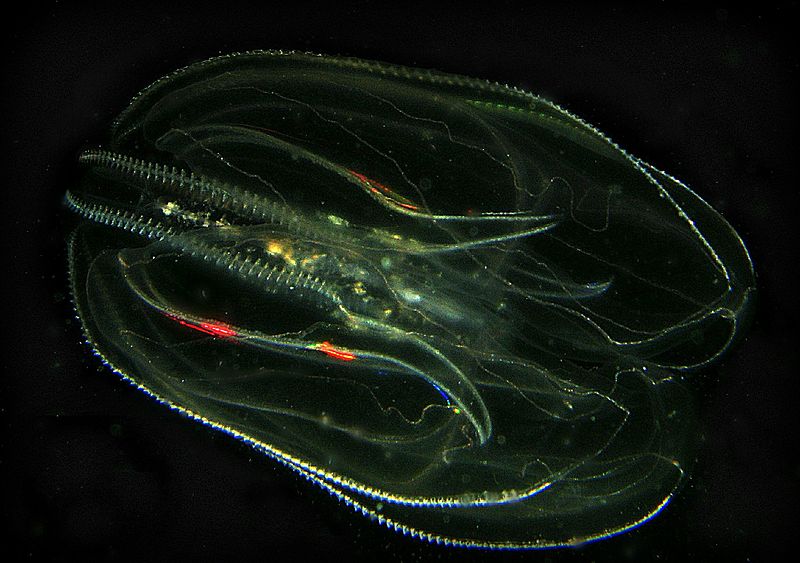
File:Mnemiopsis leidyi - Oslofjord, Norway.jpg
Sea Walnut with illuminated combs. WOW

The Mnemiopsis has a series of colored bands on their bodies made up of tiny, comb-like hairs. They all divide the body into 8 symmetrical parts, and shine magnificently when disturbed. They are iridescent, so it appears almost as if the combs change color as they move to and fro in the water. It is important to note, however, that the combs appear to shine and sparkle due to scattering light from an outside source, and not due to bioluminescence. These beautiful features do serve a practical purpose. The combs are actually used to propel the jelly through the water, similar to cilia. But its hard to marvel at the functionality of the combs when the way they look is so amazing!!!


And one final piece of info for all my loyal readers out there: The Mnemiopsis and the other comb jellies are not really that closely related to jellyfish! Jellyfish are actually in the Cnidaria phyla and Comb Jellies are in the Ctenophora phyla. Although they share gelatinous bodies, comb jellies are famous for their multicolored combs along the outside of their bodies, while jellyfish have those stinging tentacles that cause every child to fear certain scenes in Finding Nemo.

-Ian "The Rock" Dillingham


The Toad of Terror


Cane toads are widely considered one of the most invasive species in the world. You may have never heard of them, but they are a household name in Australia. They were originally introduced to sugarcane plantations in north Queensland in 1935 to control the beetle population. This resolution failed to a monumental degree. 3,000 were released into the environment, and now, there is approximately 1.5 billion of them! They thrive in Australia in such numbers because they can breed easily and there are few natural predators. These numbers have turned them into a pest species. Their toxic skin kills predators that eat them and is toxic to pets and humans. Australians are working to control the population with efforts such as encouraging the population to catch and kill them. The epidemic is getting exponentially worse as females lay clutches of 8,000 to 30,000.


Image result for cane toads
A fully grown cane toad


In other regions where they are introduced as a method of agricultural plant control (such as the Caribbean Islands and the Pacific), they have been known to eventually destroy parts of the ecosystem. This is a prime example of humans trying and failing to control natural evolution of nature. Studies have shown that introducing cane toads to a region leads to a decline in
biodiversity.


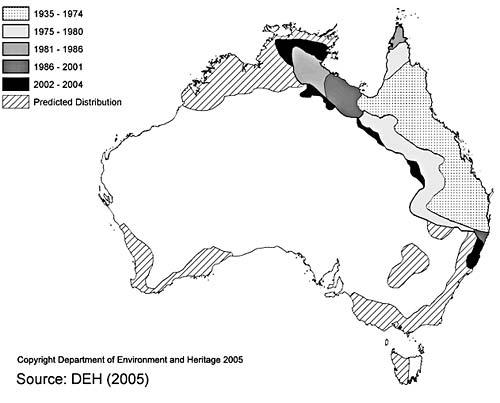
Image result for cane toad population growth in australia
Population distribution of the cane toads in Australia over the past few decades


The main concern surrounding these toads is their toxic skin that can kill both wild and domestic animals. A fun fact about that is their poison was once used to coat arrow tips and now their skin is mostly used for leather and some novelty items.

Tuesday, June 14, 2016

Grass, the Horror Story

What's the most widespread plant you see as soon as you walk into Rand Parl? It's not the trees or the flowers or any plants lining the brook, it's the grass. Grass is everywhere. It's covering the park, it's common all around the world, it's probably covering most of your lawn right now. Yet, despite its constant presence, or maybe because of it, grass is not talked about much other than needing to cut or water it. That doesn't change the fact that grass is a very influential plant in its environment.


Grass is the perfect plant to be present on lawns, golf courses, estates, etc. This is because it looks attractive, feels great on bare feet, produces fewer allergies than other plants (when it is maintained it doesn't grow enough to produce flowers), and is very resistant to trampling, temperature changes, and other environmental factors. Sadly, what we think of as common grass is likely not native to whatever region you live in. Two of the most common grasses are Kentucky Bluegrass and perennial rye grass which originate from Kentucky and New Zealand ,respectively. Additionally, most sod and bags of grass seed contain 5 to 6 species of grass to allow the grass best suited to that environment to thrive. In many cases none of those species of grass are even close to native, making those lawns covered with invasive species.

However, the fact that most commercial grasses are invasive is not the biggest problem with grass. It is a widely accepted fact that biodiversity is an essential part of a healthy ecosystem. Decreases in biodiversity lead to unbalanced populations of species, unbalanced environmental factors like the presence of chemicals, and extinction events. Grass can be the cause of a significant decrease in biodiversity.


VS


First of all, grass, with human help, practically smothers the ground it is living on, making it difficult for native plants and trees to grow. Those plants then become more sparse, making it harder for plants to have a high genetic diversity. Also, there are fewer habitats for bees in grassy areas so plants aren't fertilized as much and produce fewer seeds with a higher percentage of seeds being made from two gametes from the same plant.

Next, because the populations of many species rely on specific food sources that are being slowly replaced with grass, those species' populations will shrink in size and density, causing breeding to become rarer and the population to drop even further. For example, many birds, like the robin, eat mainly seeds. Grass does not produce seeds when it is cut regularly, like it is on most lawns, and the plants that do produce seeds are much less common. The grass most people use on their lawns decrease the biodiversity of native plants and animals, sometimes even to the point of becoming endangered.

Thankfully, there are a few ideas in circulation of ways to stop this downward spiral. One is to plant clover instead of grass. Clover covers the ground just as well as grass does, and is durable. It also doesn't grow very tall and therefore needs to be mowed less, and it produces flowers low to the ground, meaning seeds and nectar are produced which will feed bees and birds. Another idea is to leave part of your yard completely untamed, allowing anything and everything to grow back there. This will give native plants a place to take hold and thrive so they don't disappear from suburban areas.

You can't even tell it's clover

Even if you don't want to plant clover or leave part of your lawn untamed, you should still host something native, or at least let the grass grow high enough to produce seeds. Recently the grass in Rand Park was left unmowed, and the grass grew tall enough to produce seeds within a few weeks. Anything that will provide food or shelter for native wildlife is a step in the right direction. So what are you waiting for? Go out there and stop planting grass!

Knowing is Caring: An Exploration of Rand Park's Inhabitants


In early May students attending Ms. Weeg’s, Mr. Ambrose’s, Ms. Wright’s and Ms. Chmura’s biology classes engaged in an activity based partly in ecology and partly in philosophy. They were presented with a lesson detailing the complex interactions between wolf, moose, and fir trees on Michigan’s Isle Royale as provided by Michigan Technological Institute's John Vucetich.  Despite the extraordinary life needs of the organisms involved and the dramatic scenario of predation between the three, the lesson concluded with two surprising central questions: “Do we now care?” and “Why do we now care?”
            Initial answers came easily enough. Students felt that they should care because it concerned balance (or lack thereof) within an ecosystem. They felt that it was their duty to care about such things because ultimately, any imbalance would impact them. Before long, the complex nature of the question was highlighted; teachers pointed out that Isle Royale is completely isolated from any main land, that its ecosystem is atypical from most others, and that what occurred there had almost nothing to do with what occurred in Montclair.  It was then posed that the answer might be of a much simpler nature: We suggested that they now care because they now know. Observing a species with great scrutiny, knowing how it struggles or thrives throughout its life cycle, instills one with the capacity for empathy. Empathy might have the power to encourage emotional investment in our students and we were wholly ready to take advantage of that.
            This was the birth of the multi-phased project “To Know is to Care”, throughout which students would take a detailed look at Rand Park, note the subtle differences between its voluminous inhabitants, and investigate the life of one in particular.
            The project began with the creation of a dichotomous key concerning aquatic and terrestrial autotrophs and heterotrophs within our sample ecosystem. During this phase students discovered that the trees they had previously seen as one general species consisted of multiple species possessing only slight differences in visible traits. They learned that the wood sorrel they first knew as clover was drastically different from the luck bearing plant, and that as much was evident from its sour citrus like flavor and heart shaped leaves.  Students overcame their fear of wild water and delved into the brook to overturn rocks in search of carnivorous leeches, gentle snails, and wonderfully slimy planaria. 

Mr. Ambrose describes the rich ecology present on a single rock found in the brook (photo credit: Susan Eckert)

            The excitement for choosing the focal organism for phase three of the project was palpable. Students raced to find their teacher at the completion of identifying, photographing, and labeling all key species, hoping that they would be able to select the organism they were most interested in before any of their classmates could.
            Students next engaged in the last phase of the project. They conducted research regarding specific criteria on the organism they chose: What was its life like? What organisms facilitated its existence in the park? Which would it loathe to encounter? These questions and more served as an avenue towards “knowing” not only the organism they selected, but also any organism with which it interacted. 
         After spending nearly two hours of critical observation on avian, mammalian, and other species within the park and spending twice as much investigating one of those species in particular, it was clear that students had grown to see Rand park, not just use it. They had come to know the intricacies of its community, and we dare hope that knowing may have led them to care