For those who have encountered the combatant pigeons of New York City, it likely comes as no surprise when I say that birds that live in the city have different behavioral patterns. The environmental conditions in the city are so drastically different than those of rural areas, that they place a selective pressure upon the birds, causing them to biologically adapt over time. In some ways, the pressures caused by city life can improve populations of birds, and in other ways, they are put at a disadvantage.
Birds in the city are forced to face several environmental differences that affect how they must behave to survive. There is a heightened amount of stimulus as well as population density in cities. At any given moment, there is noise, traffic, bright lights, and many people and different types of animals fighting for space and resources. In order to survive and reproduce, city birds tend to be forced to adopt a more aggressive demeanor and be willing to fight and assert themselves when necessary.
When observed, urban birds show off their aggressive sides in response to trouble. Much of this comes from biological evolution over time, but in addition to the foundation that evolutionary tendencies provides, the frequency of exposure to situations like these makes the birds better equipped for conflict going forward. Birds in the city also show raised aggression during mating as a result of the density of competition.
Additionally, it was found that city birds may even have a greater immune system and higher intelligence than country birds. I would hypothesize that their immune system would be better as birds are exposed to a much less clean environment, exposed to pollutants and food scraps, and therefore would naturally build antibodies to different pathogens more quickly. They could also have become genetically predisposed to have a better immune response over generations (read more about inherited immunity here).
One downside of life in the city for birds is the potential of more stress, which can shorten the length of their telomeres. Telomeres, which are like caps on chromosomes, shorten over time, and their shortening can decrease one's lifespan. With exposure to a great amount of stressors, city birds may face more wear and tear than country birds.
It is up to you whether you find that city birds or country birds are superior. Frankly, there is no true purpose in determining which type of the amazing creatures reigns supreme. City birds seem to mirror their human city-mates, having to endure great stress, but resultantly becoming more aggressive and well-equipped in the face of conflict. Country birds are not as likely to have these traits, but they also face much less external stress. The choice is up to you; Team City Bird or Team Country Bird?
A window into the world of biology in the leafy suburb of Montclair, NJ. Written by students save for a few bio teacher posts.
Showing posts with label birds. Show all posts
Monday, May 28, 2018
Monday, May 21, 2018
Parasitic Cuckoos and AP Bio Memes
After taking the AP Bio exam, I was perusing the #apbio twitter tag and stumbled upon this meme which made me laugh exceptionally hard.
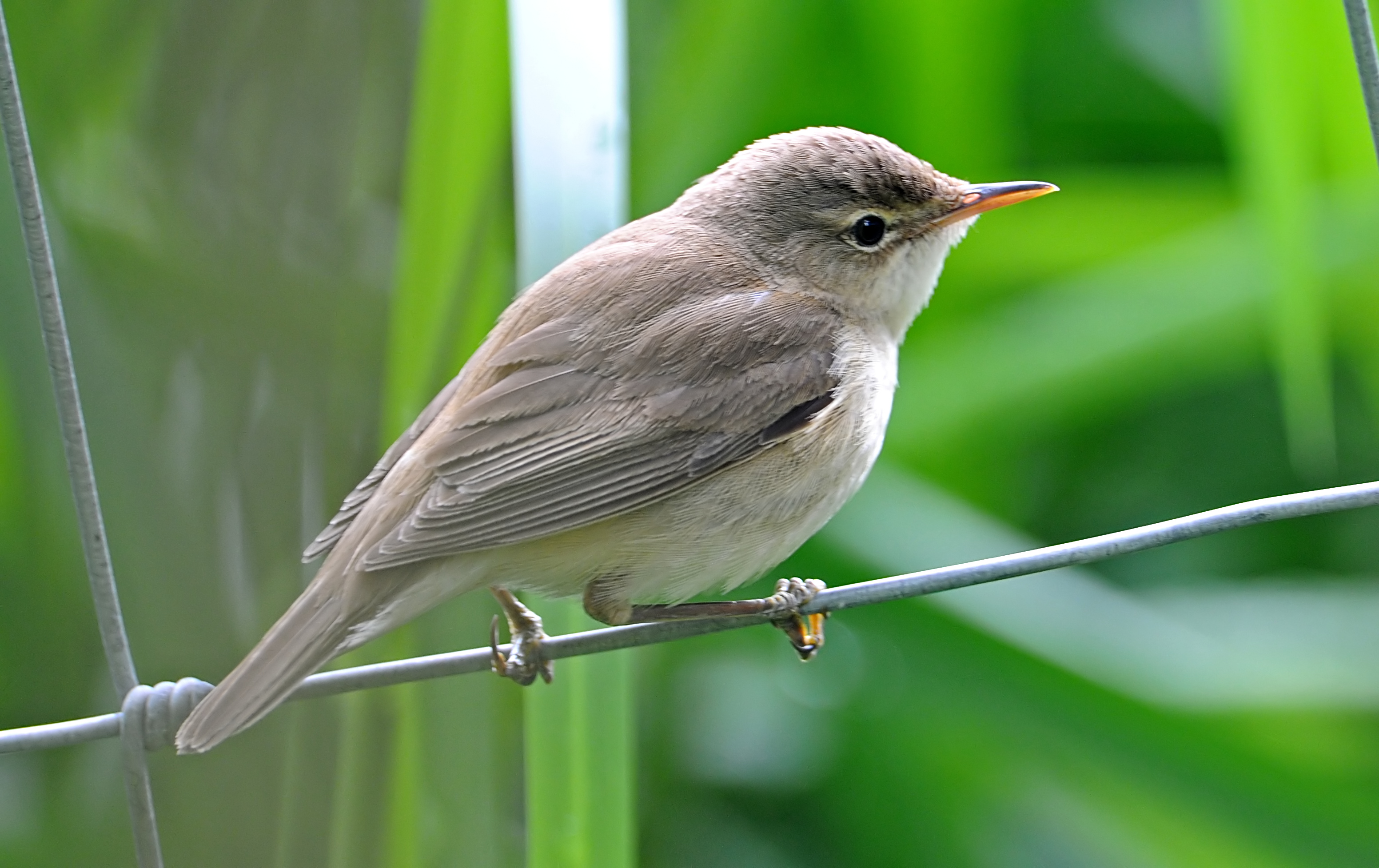
After doing some research, I realized the two species of bird have been coevolving. The cuckoo is a brood parasite, which means it lays its eggs in the nests of other birds, thus forcing the unwitting "foster parents" to hatch and raise the cuckoo's chicks. And because they have been dropping their eggs in the reed warblers' nest so often, the two species have both been trying to find new ways to outsmart one another over the generations.
![]() |
| A Reed Warbler! How cute <3 |
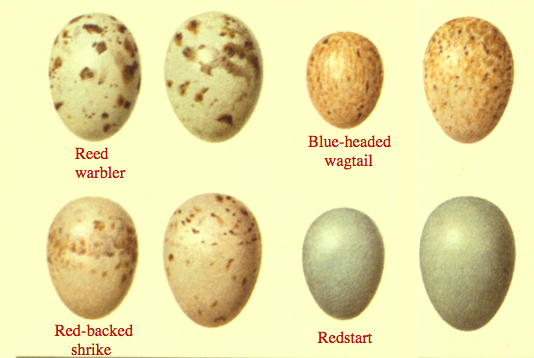
However, the cuckoo has adapted over time to lay eggs with patterns that are almost indistinguishable from the warbler's own eggs.
![]() |
| Cuckoo egg patterns mimic their various host's egg patterns |
And warblers have evolved to nest in communities so as to have a sort of 'neighborhood watch' going on at all times. But cuckoo birds actually watch the community of warblers to find the weakest link and swoop in at the right time to swap out one of the warbler's eggs with their own. The whole switch only takes about 10 seconds, too!
Once the egg is in the nest, it's virtually indistinguishable to the warbler who then raises all of the chicks in their nest. After the cuckoo chick is hatched, however, it will take the initiative to eject all of the other eggs in the nest! It does this by pushing the eggs out with its back. Once there are no more chicks to compete for food with, the cuckoo continues to grow and demand food from the warbler until it grows to be too big for the nest and far bigger than the warbler. It reaches its adult size in just two weeks.
And after the full-grown cuckoo leaves the nest and moves on to mate, the process is repeated!
I truly learned something new about the avian world thanks to this year's AP Bio exam and I hope you did too :D
-----------------
Also, while researching all of this, I showed some videos to my friends, told them about the parasitic relationship that cuckoo birds have with their hosts and asked what their opinions were. The general consensus was that cuckoo birds are terrible to their hosts.
I'd have to agree. They are some horrible house guests.
Labels:
ap bio,
ap bio exam,
ap bio exam memes,
ap bio memes,
birds,
cuckoos,
environmental science,
evolution,
memes,
parasitic birds,
parasitic cuckoos,
reed warblers,
spotted cuckoos,
warblers
Wednesday, June 1, 2016
Baby Birds in Our Own Backyard
There’s a robin’s nest in Rand Park! And it has baby birds in it! To protect the birds we can’t disclose its location. When we first discovered the nest, there were three baby birds and two unhatched eggs. We knew they were robins because of the blue eggs. The blue color in robin eggs is due to biliverdin, a pigment deposited on the eggshell when the female lays the eggs. There is some evidence that higher biliverdin levels indicate a healthier female and brighter blue eggs. Eggs laid by a healthier female seemed to encourage males to take more interest in their young. Robins usually lay four eggs and then stop, which was the case with this mother robin. Typically the mother lays one egg a day and then the eggs hatch in the order they were laid in. In that case, the two unhatched eggs were laid later than the hatched eggs. The female incubates the eggs for two weeks until they hatch and then both parents care for the young.
I raised a baby robin a couple years ago named Chirp Chirp. He was a fledgling when I found him but he wasn’t old enough to survive the world on his own. I fed him cat food dissolved in water from an eyedropper because it is a good source of protein and fiber. I squirted the food into his open mouth from above to try to mimic his parents throwing up into his mouth (ew!). When he got older I bought mealworms from Petco and dangled those above his head.
| I didn't get a picture of the birds before hatching but here's a picture from Google Images. |
The babies will become fledglings two weeks after they hatch, which means that their feathers and wing muscles are developed enough for flying but they are still dependent on the care of the parent. Birds learn to fly through practice, guided by their innate ability and the example of their parents. Flying is an innate ability but a learned behavior.
A majority of the robins fly south for the winter, but some stick around. Robins that do not migrate tend to move around during the winter, motivated by food. Robins eat berries in the winter and worms and insects in the spring when the ground thaws. Robins have to wander around during the winter to follow the food supply.
The mother robin starts screaming when I get near the nest to take a picture. I’ve only done it twice because I don’t want to cause her or the babies any stress. Contrary to popular belief, parents will not abandon their babies if they come in contact with humans. However, if you find this nest or any other, PLEASE respect the birds and don’t mess with it or share with anyone else.
| First picture of the babies taken on May 23rd |
![]() |
| Second picture of the babies taken on May 26th! Look how much they've grown! (creds to Ms. Eckert for the photo) |
| Creds to Google Images |
He got really good at flying and I was so proud. I’m not sure how he learned because he didn’t have a real bird mom to teach him but maybe he learned by watching birds outside. The interweb says flying is a learned behavior but this experience made me think it is more innate. Chirp Chirp soon flew away from me and I cried, but I couldn’t be more proud of my baby. Every time I see a robin I think of him and wonder if it’s him coming back to say thank you.
UPDATE!
The kids have left the nest! Ms. Eckert brought the nest inside. Most websites say that robins don't reuse their nests. One says that they sometimes build on top of them or reuse parts of it. I think it might have been better to leave it where it was but looking at the nest up close allowed us to see how the robins had constructed it. We saw that it had a plastic bag and the plastic ring around the top of bottles. Do you think these materials are dangerous for the birds? Maybe it's time to start throwing our trash where it belongs- in the garbage can.| The empty nest :( A sad but proud moment |
Saturday, May 28, 2016
Birds Beware: Unexpected Discoveries in Rand Park
For the past two weeks, my class and I have been working on clearing out the tulips planted against the wall of the Atrium in Rand Park and discussing what should be planted in place of the tulips. While we decided that rosemary would be a good addition to Rand Park instead of the tulips that had begun to brown and die, the process of cleaning out the tulip boxes and ensuring that the rosemary would be placed in soil sustainable to their growth has not been an easy task. Among the treasures I found while pulling out the tulips were various insects, weeds, candy wrappers, plastic bottles and dirty papers, but there was one unanticipated organism I came across that I had never seen before.
My first reaction to a small red creature that I saw in the soil was fear, then disgust, but eventually I learned that this arthropod is typically harmless to most mammals. While I am not totally sure what creature I found crawling in the tulips, I narrowed the possibility down to three different mites, small arthropods the belong to the subclass Acari. Mites prefer to live in an environment with high organic matter content and moist conditions. The three possible mites that I could have found in Rand Park are: red mite, spider mite and clover mite. Most likely, the mite that I came across was Dermanyssus gallinae, or red mite, an ectoparasite to poultry. While red mite may occasionally cause skin irritation for humans, birds in Rand Park may have legitimate reason to fear for this small red parasite typically found among the cracks and crevices of concrete. Red mite are blood feeders and attack birds at night, staying in the cracks and crevices of concrete until the sun has gone down. They are typically white or gray, but after feeding become engorged with blood and turn red. Red mites are vectors of diseases, indirectly affecting the health of birds. Spider mite spin protective silk webs on the undersides of leaves, where they generally live. They can cause damage when they feed by puncturing plant cells. Bryobia praetiosa, or clover mites, were my second guess for the red creature I discovered in the soil in Rand Park. They are reddish-brown, most prominent in the Spring and prefer habitats with thick vegetation (one reason I believe they are a contender for the creature I found).
Assuming my prediction is correct and the arthropods I came across were red mites, they may not affect the rosemary that will soon be planted, but they can cause indirect harm to the birds living in Rand Park. Stay tuned for a post about the adventure and difficulties of planting rosemary!
Subscribe to:
Posts (Atom)